Faculty and staff resources
Resources, policies and classroom support

Teaching resources
Classroom AV support, class rolls, e-learning services, and other resources to support our faculty.
Curriculum development
The Warrington College of Business encourages innovative course creation and supports forward-thinking curricular development.
Faculty Annual Report
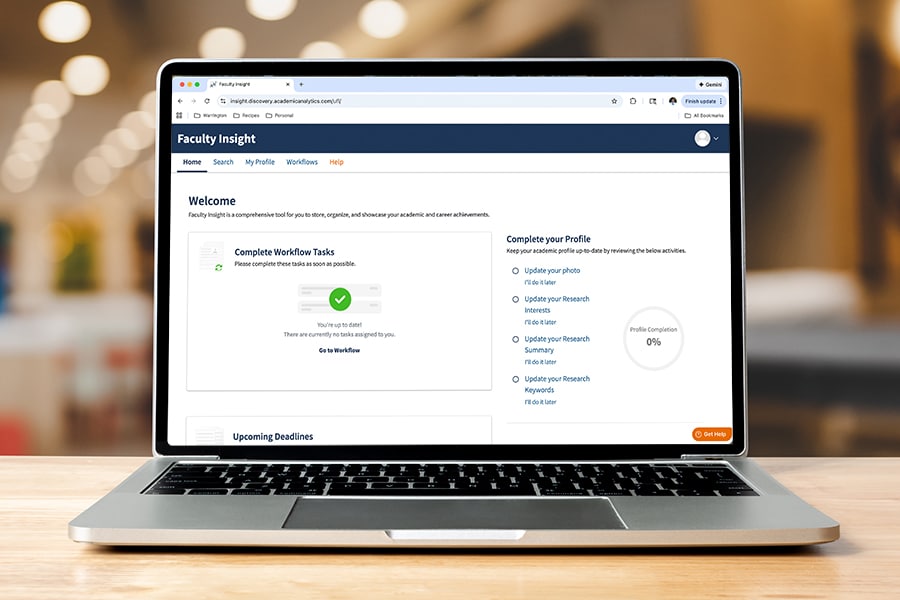
Login to Faculty Excellence and Advancement (FEA).
Previous platform: Faculty Success / Digital Measures. Please do not enter new information in Faculty Success.
IT Support
From computer systems to mailing lists, the Information Technology Support Programs support the use of technology, information and communication.

Regulations and policies
UF faculty handbook, research at UF, structure and governance, Warrington and UF policies, and other support for faculty and staff.

Room reservations, visitors and events
If you are arranging for a speaker or guest program participant to visit our campus, register your visitor now. You may also need to reserve rooms, add speakers to our College calendar, or request parking.

Directory profiles
Information on the profile pages can come from various sources including UF, Warrington and Faculty Excellence and Advancement data, as well as our Newsroom.

College committees
Member listings, annual reports, meeting minutes and bylaws.
Faculty enhancement & review
Tenure, promotion, review and other information and resources.

FERPA certification
Resources and training to become FERPA certified.
Request a Business Career Services Workshop
Career Coaches offer workshops to academic classes and student organizations on topics such as resume writing, interviewing, elevator pitches, career fair prep, LinkedIn and more.
Quick access to tools and resources
Requests
Request access to Warrington’s electric car
Warrington’s electric car is available for full-time faculty and staff only. Park it in any UF service drive, brown, orange, or red parking lot. State vehicles can park in metered parking for free. Don’t park in a reserved spot. If you get a ticket, pay it yourself. The EV is on the EMS room schedule and available for a UF Business purpose. Only approved individuals with the necessary criteria can reserve it in the EMS system. The college must follow University-Owned Vehicle Usage procedures. Any operator must meet these criteria: possess a valid driver’s license, clean driving record, and be employed full-time as faculty or staff.

Request your keys
Login to request keys for Warrington campus buildings and offices.

Visitors, events and reservations
If you are arranging for a speaker or guest program participant to visit our campus, register your visitor now. You may also need to reserve rooms, add speakers to our College calendar, or request parking.
Register your Warrington visitor
Speakers and campus guests should be registered through our short online form. GatorLink login is required. Once you submit the registration you will receive a confirmation along with the registration number and then you can proceed to the request parking link, if needed. The guest registration number is required prior to parking being approved.
Parking requests
You are required to register your guest before requesting parking and receive a registration number. Parking is requested by authorized personnel only. If you are not authorized, contact your office manager or email Daisy Johnson.
Enter your parking request in this format under the Event Name: Guest Registration #/College/Department/Guest Name/Name of company guest is from.
Example: 48532/WCB/DEAN/KAREN SMITH/DISNEY
GatorLink guest accounts
If your visitor or guest needs to log on to the College computers you will need to create a GatorLink visitor account. Please go to the UF Identity Coordination Page to follow the instructions to create a guest account in MyUFL Account Management.
Room reservations
Review room use policies and A/V instructions. Make reservations for Heavener Hall, Gerson Hall, Hough Hall, Bryan Hall, Stuzin Hall, and Matherly 120.
College calendar
You can add events, info sessions, speaker series and other events to our college calendar.
Policy for reservations
- This room is located in the Dean’s office suite and only available Monday-Friday 8:00 a.m. – 5:00 p.m.
- Chairs and tables rearranged must be returned to the original set-up.
- Food/beverage is allowed in the Dean’s conference room but must be properly disposed of immediately after your event.
- Caterers or meeting organizer is expected to clean up in a timely manner and take all trash to the dumpster. Do not leave any trash in the building.
- Housekeeping leaves every day at 1:30 p.m., but it is not their responsibility to remove the trash and/or clean/rearrange the tables, etc. after any event.
- If the air conditioner is adjusted for your event, please make sure it is set back between 70 -75 degrees before departing.
- The Technology Assistance Center can be contacted at 273-0248 regarding questions about the equipment.
- Student groups needing access to equipment should contact the TAC to come over and start the equipment.
- Please be sure to leave the room clean and ready for the next group to use (trash removed from the building, tables wiped, chairs pulled up to tables, white boards cleaned, etc.).
- If you experience any problems upon arrival with the room not being acceptable for use please contact the Dean’s Office at 352-392-2397.
- This room is locked and you will need to check out a key from the Dean’s Office, 100 Bryan Hall.
- This room can not be used for Class purposes.
- This room can not be reserved for the same event for an entire semester.
- Food/beverage is not allowed in the auditorium.
- The Technology Assistance Center can be contacted at 273-0248 regarding questions about the equipment.
- Student groups are not allowed to use this room unless a faculty advisor is present.
- Please be sure to leave the room clean and ready for the next group to use.
- If you experience any problems upon arrival with the room not being acceptable for use please contact the Dean’s Office at 352-392-2397.
- This room is locked and you will need to check out a key from the Dean’s Office, 100 Bryan Hall.
- This room can not be used for Class purposes.
- This room can not be reserved for the same event for an entire semester.
- Food/beverage is allowed in this room.
- The Technology Assistance Center can be contacted at 273-0248 regarding questions about the equipment.
- Student groups are not allowed to use this room unless a faculty advisor is present.
- Please be sure to leave the room clean and ready for the next group to use.
- If you experience any problems upon arrival with the room not being acceptable for use please contact the Dean’s Office at 352-392-2397.
The person making the request will be held responsible for making sure the room usage policy/procedures are met.
- No food/drinks are allowed in any Gerson Hall classrooms. This includes Gerson 121, 122, 126, 228, or 229. If you are planning food for your event, your request must include reserving the Gleim Atrium, and you must plan on restricting food to that area.
- Accounting students have access to study space in Gerson Hall. More information on these areas, including eligibility and terms of use, can be found on the Accounting students web page.
- Employers wishing to schedule recruiting events exclusively for accounting students should use the Employer reservation request form. Do not use this form for any other purpose.
- Student organizations: Student organizations with a focus on accounting may reserve classrooms in Gerson Hall for meetings or events. Student organizations should submit any reservation requests through the Business College Council. A primary contact will be provided to the student organizations by the Council each year. You may email BCC for more information. Student organization reservation requests will not be approved prior to the following dates:
- Fall semester: August 1
- Spring semester: December 15
- The room must be left clean (trash picked up, tables wiped if necessary, chairs pulled up to tables, etc.) for the next occupant. Gerson Hall classrooms do not have trash receptacles in them, but there are receptacles in the hallways.
- Chairs and tables must be returned to the original set-up.
- If there is a problem with the equipment, contact the Technology Assistance Center (located in Heavener Hall 202) at 273-0248.
- Requests should be submitted at least 3 business days prior to the event.
- Building hours:
- Monday through Friday, 7:00 am – 8:00 pm
- Closed on weekends and university holidays
Failure to comply with Gerson Hall room policies and procedures could lead to automatic cancellation of any current reservations and prohibition of reservations in the future.
If you experience any problems with the room (other than with the technology), please contact the Fisher School of Accounting in 210 Gerson Hall or 352-273-0200 during normal business hours.
The requester, as a representative of the organization will be held responsible for making sure the room usage policy/procedures are met.
- The Heavener Classroom policy is no food/drinks allowed. If you are planning food for your event your request must include reserving the Student Commons or Heavener Courtyard.
- The room must be left clean (trash picked up, tables wiped if necessary, chairs pulled up to tables, etc.) for the next group using it.
- Reservations should include enough time to arrange the room to your preference and then back to its original set-up (Suggestion: 15-30 minutes prior to and after).
- Heavener Hall classrooms do not have trash receptacles in them but there are receptacles outside of the classrooms through the building.
- Chairs and tables must be returned to the original set-up (example located on wall).
- If there is a problem with the equipment, contact the Technology Assistance Center (located in HVNR 202) at 273-0248.
- Heavener Hall 160, The Bill Alcorn, Multipurpose room stays locked at all times.
- Heavener Hall 160 is not intended for Student Organization use.
- HSB staff must be present to oversee the entire event.
- Only HSB staff can access the room with their Gator1 ID card.
- Do not prop the door open.
- All request must be submitted 3-5 days prior to the event and at least one day notice in advance of any change or cancellation.
- Building Hours
- Monday through Thursday 7:00 am – 12:00am
- Friday from 7:00am – 8:30pm
- Closed on weekends and holidays
Failure to comply with Heavener Hall room policies and procedures could lead to automatic cancellation of any current reservations and limited reservations in the future.
Our goal is to ensure that the space is acceptable for use. Please notify the Center for Career and Leadership Development office in 333 Heavener Hall or (352) 273-0165 of any problems you may experience upon arrival.
- The room/building may need to be unlocked for your event.
- Email Addie Atkins after you receive a confirmation to either schedule the room to unlock or activate Gator 1 card swipe access.
- The building is automatically locked at 7:00 p.m.
- You can work with the building monitors either Jim Silk or Justin Hundersmarck to ensure your guest will be able to enter after 7:00 p.m.
- Jim or Justin work every day from 7p-2a and can usually be found near the south entrance.
- If your guest(s) have a Gator1 card and will be accessing the building on a regular basis you can request card swipe access by emailing Addie Atkins.
- Hough Graduate School or a class schedule change has priority over events and your group could possibly be asked to relocate if this becomes necessary.
- Chairs and tables rearranged must be returned to the original set-up upon departure.
- Food/beverage is not allowed in any of the classrooms except for Hough 120A/B.
- Food/beverage is allowed in conference rooms (120A/B, 338, and 202) but must be properly disposed of immediately after your event.
- Caterers or meeting organizer is expected to clean up in a timely and take all trash to the dumpster. Do not leave any trash in the building.
- Housekeeping leaves every day at 1:30 p.m., but it is not their responsibility to remove the trash and/or clean/rearrange the tables, etc. after any event.
- If the air conditioner is adjusted for your event, please make sure it is set between 70 -75 degrees upon departure.
- Turn off light upon departure.
- The Technology Assistance Center can be contacted at 273-0248 regarding the equipment.
- Student groups needing access to equipment should contact the TAC to come over and start the equipment.
- Leave the room clean and ready for the next group to use (trash removed from building, tables wiped, chairs pulled up to tables, white boards cleaned, etc.).
- Please make sure the door is closed properly and locked when you are done using the room.
- If you experience any problems upon arrival with the room not being acceptable for use please contact the Dean’s Office at 352-392-2397.
- This classroom has restrictions.
- The door is kept locked and requires a key to be checked out from the Dean’s Office, room 100 Bryan Hall.
- The key must be returned after the event unless it is reserved during the evening and then the key can be returned the next morning by 8:00 a.m. or if on the weekend by 8:00 a.m. on Monday morning.
- If your reservation is on the weekend you’ll need to check out a key to the room and building by Friday 5:00 p.m.
- Only faculty or staff of Warrington are allowed to request use of this room with the following conditions:
- Use of this room requires a faculty or staff member to be present.
- Reservations will only be approved for events that require to use of the technology this room offers.
- A class schedule change has priority over events and your group could possibly be asked to relocate if this becomes necessary.
- No student groups are allowed use of this room.
- Chairs and tables cannot be rearranged in this room.
- Food and beverage is not allowed in this room.
- No catered events is allowed in this room.
- If the air conditioner is adjusted for your event, please make sure it is set between 70 -75 degrees upon departure.
- Turn off lights upon departure.
- The Technology Assistance Center can be contacted at 273-0248 regarding the equipment.
- Please be sure to leave the room clean and ready for the next group to use (trash removed from the building, tables wiped, chairs pulled up to tables, white boards cleaned, etc.).
- Please make sure the door is closed properly and locked when you are done using the room.
- If you experience any problems upon arrival with the room not being acceptable for use please contact the Dean’s Office at 352-392-2397.
- Stuzin classrooms are unlocked Monday-Friday during the day and evening until 10:00 p.m.
- If your reservation is on the weekend you’ll need to check out a key from the Dean’s office by Friday 5:00 p.m. and return by 8:00 a.m. the following Monday.
- A class schedule change has priority over events and your group could possibly be asked to relocate if this becomes necessary.
- Food/beverage is not allowed in any of the classrooms.
- The Technology Assistance Center can be contacted at 273-0248 regarding questions about the equipment.
- Student groups needing access to equipment should contact the TAC to come over and start the equipment.
- Please be sure to leave the room clean and ready for the next group to use (trash removed from the building, tables wiped, chairs pulled up to tables, white boards cleaned, etc.).
- Please make sure the door is closed properly when you are done using the room. No propping doors open.
- If you experience any problems upon arrival with the room not being acceptable for use please contact the Dean’s Office at 352-392-2397.
- This conference room is kept locked and requires a key to be checked out from the Dean’s Office, room 100 Bryan.
- The key must be returned after the meeting unless the meeting is during the evening and then the key can be returned the next morning by 8:00 a.m.
- If your reservation is on the weekend you’ll need to check out a key to the room and building by Friday 5:00 p.m.
- Chairs and tables rearranged must be returned to the original set-up upon departure.
- Food/beverage is allowed in conference rooms but must be properly disposed of immediately after your event.
- Caterers or meeting organizer is expected to clean up in a timely manner and take all trash to the dumpster. Do not leave any trash in the building.
- Housekeeping leaves every day at 1:30 p.m., but it is not their responsibility to remove the trash and/or clean/rearrange the tables, etc. after any event.
- If the air conditioner is adjusted for your event, please make sure it is set between 70 -75 degrees upon departure.
- Turn off lights upon departure.
- The Technology Assistance Center can be contacted at 273-0248 regarding the equipment.
- Student groups needing access to equipment should contact the TAC to come over and start the equipment.
- Please be sure to leave the room clean and ready for the next group to use (trash removed from the building, tables wiped, chairs pulled up to tables, white boards cleaned, etc.).
- Please make sure the door is closed properly and locked when you are done using the room.
- If you experience any problems upon arrival with the room not being acceptable for use please contact the Dean’s Office at 352-392-2397.
- Bryan 101A
- Bryan 232
- Stuzin 200
- Warrington Courtyard (outside events – between Bryan and Gerson)
- Emerson Courtyard (outside events – between Stuzin, Bryan and Matherly)
- Gerson 327
- Gerson Student Commons area (only special events coordinated by the Fisher School of Accounting)
- Heavener 305
- Heavener 306
- Heavener 160 (special events only, grand guard luncheon, receptions, advisory board meeting, dinner)
- Heavener Courtyard (outside events)
- Hough 120 A/B
- Hough 202
- Hough 338
- Hough North Court (student events, luncheons, receptions, advisory board meeting, dinner)
- Hough South Court (student events, luncheons, receptions, advisory board meeting, dinner)
- Hough Courtyard (outside events)
For outside events, tent cost is approximately $400.

Faculty and staff awards
Teaching resources
- Graduate Academic Calendar
- View Graduate Business Course Schedules
- Manage Graduate Business Course Schedules
MBA student performance and accountability
Hough Graduate School of Business
Warrington College of Business
The University of Florida
Overview
The MBA Faculty Program Committee has adopted the following guidelines for MBA programs. These guidelines are intended to foster excellence in our programs by building and maintaining a high performance culture in which students continuously develop into managers who are worthy in every respect of the trust and responsibility that organizations and society posit in them. Fostering excellence requires not only an intellectually challenging curriculum but also an environment of professionalism in all aspects of the program.
Academic integrity
Academic integrity and honesty are essential in the development of a professional manager. This society is not willing to tolerate dishonest or otherwise unethical professional business managers, and this MBA program will not do so either. Students must attend to, and follow, the University of Florida code of student conduct, with special attention to academic integrity and academic honesty. They must never appropriate the ideas and work of others, including both academic sources and fellow students, without appropriate attribution or by claiming others work as their own. They must exercise complete honesty in following the conditions established by the instructor for examinations and other assignments. Finally, they must be honest with one another, be willing to be accountable for their own failures of honesty and integrity, and not tolerate such failures in classmates.
Respect
A professional and high performance culture requires respect for the learning process, for human dignity, for the ideas and the work of others in the MBA community, and respect for the significant human and financial resources that are invested in MBA education from many sources. Most importantly, students must respect their own personal commitment to earning an MBA degree. They must devote the necessary time, attention, and best efforts to their education, consistent with the demands of each program format.
Procedures
To ensure that students maximize the value of their educational experience, procedures related to grading, attendance, team and individual work, and expectations are outlined below:
Grading
- Beginning with new cohorts of students entering Hough MBA programs after the effective date of this policy, required core courses and all courses in the working professional MBA programs will maintain a maximum mean grade point average of 3.5 (for example, 25% A, 50% B+, 25% B).• Grades of C+, C and below can and will be given when student performance warrants.
- Employer reimbursement policy should not affect the grade a student earns for any course.
Attendance
- With few exceptions, students must treat class attendance as an academic appointment that must be met, much as one must meet a business appointment. Students are expected to attend all scheduled class sessions and to use their nameplates to identify themselves.
- In the working professional programs, missing a weekend means missing as much as 25% of the course contact time. If you must miss a working professional class, you must notify the MBA Programs office, with your reason, in advance, or in case of an emergency, as soon thereafter as possible. The MBA Programs office will report all absences to faculty periodically during the term.
- In the traditional programs, absences should be communicated in advance to the course instructor, or, in case of emergency, as soon thereafter as practicable.
- Unexcused absences or multiple reported absences often reflect a lack of academic and professional commitment and will usually result in a considerable penalty in final grading.
- The MBA program office will contact students who consistently miss class sessions but remain in good academic standing (3.0 and above) and strongly encourage them to recommit themselves to, or withdraw from, the MBA program.
Team work and individual work
- Working in the context of groups and teams is an important managerial skill that is fostered in the MBA programs. Students should treat their responsibilities to team appointments and team work as they would treat professional business obligations.
- Learning in the context of groups and teams also involves academic integrity. Team members are jointly responsible for the academic honesty and integrity of team work. They are obliged to participate in the work and learning process of the team so that they do not take academic credit for projects and assignments to which they have not made a fair and proportionate contribution.
- Assessment in most MBA classes will involve both individual and group work. Faculty members are encouraged to make individual work account for at least 50-70% of the students’ grades, so that individual learning is assured.
- Faculty members are encouraged to incorporate peer evaluation of team member performance into final course grades.
Classroom expectations
- Students are expected to be punctual in class attendance and remain in the classroom for the entire class session, as they would in any business appointment, unless an urgent need arises or prior arrangements have been made with the instructor.
- Students are expected to arrive for class prepared to meet classroom obligations and to devote full attention and commitment to the work of that class.
- Laptops and other electronic devices should be used with discretion and only as permitted by the instructor for work directly related to the class session. Emailing, accessing the internet, and working on matters unrelated to the work at hand are inappropriate behaviors because they are disrespectful and distracting to the class and to the instructor. In the rare but urgent situation, the student should advise the instructor in advance of a pending phone call or message.
- Classroom discussion is an important part of the pedagogy of many MBA courses. Students in these classes should be fully prepared to engage in class discussion, and they should use the opportunity to develop positive and professional communication skills. This includes according respect for differing perspectives and contributions to discussion, as well as building on the base for discussion laid by student colleagues and the instructor.
- Faculty members are encouraged to hold students accountable through “cold calling” and in-class assessment of preparation and learning.
Students who continually fail to meet these expectations should expect academic penalties and possible dismissal from the program. We believe that these principles, in conjunction with our high expectations, will result in a stimulating and productive MBA experience for students and for faculty.
Teaching evaluation policy
College guidelines
Even though the University does not require any section to be evaluated if there are less than 10 students enrolled in the class, the College of Business does require all sections to be evaluated no matter how many students are enrolled. This relates only to sections of courses that should be evaluated and does not override the University decision regarding evaluations for independent study, internship, practica, thesis, and dissertation supervision courses. Sections of these exempted courses still do not need to be evaluated. This means that the exceptions listed under University Guidelines are still in effect with the exception of the exclusion based on class size.
Directory profiles
Do you need to make updates to your CV, bio or other directory information?
Information on the profile pages can come from various sources including UF, Warrington and Faculty Excellence and Advancement (FEA) data, as well as our Newsroom. As faculty and staff of Warrington, you can edit some of your own information. Knowing where the information is coming from and who to contact for help is the key.
Designated directory editors can make edits for people in their unit. In addition to what you can edit, they can also make some changes to positions, titles and affiliations.
Departments:
- Finance, Insurance & Real Estate Dept: Melissa Hale, Donna Rivera
- Information Systems & Operations Management Dept: Elizabeth Thomas, Jaleesa Dixon
- Management Dept: Sokha Ward Peck
- Marketing Dept: Shawn Lee, Phillip Isenhour
Centers:
- David F. Miller Retail Center: Margaret Jones
- Entrepreneurship and Innovation Center: Jerrica Wilkins
- Kelley A. Bergstrom Real Estate Center: Martha Collada
- Management Communication Center: Robyn Crawford
- Public Utility Research Center: Rebecca Beachy
- Teaching and Learning Center: Renee Young
Schools, offices & programs:
- Business Career Services: Genaveve Polhill, Morgan Starling, Veena Garb, Diana Saiz
- Fisher School of Accounting: Tiffany Gauthier
- Heavener School of Business: Jennifer Parsons
- Information Technology Support Programs: Angela Perry, Catalina Aragon, Tina Nguyen
- MBA: Debbie Pastrana Rodriguez, Gus Kreatsoulas
- Office of the Dean: Daisy Johnson, Ainsley Thomas
If your immediate unit is not listed, refer to the department your unit is affiliated with. If a designated directory editor has questions, they should contact Laura Braden.
Update your CV, links, bio and research areas, plus control news and FEA data.
To make edits to the college database, log in to the college directory and use the search feature to find your entry. The editable information includes:
- Public & Personal tabs: These two tabs show some basic information about you. The blue “UF” links will take you to myUFL/One.UF. Please see the myUFL/One.UF section below for more information on where to edit your UF directory information.
- Links tab:
- Homepage: If you have a professional website, enter the full web address in the field provided. It must begin with http:// or https:// to be valid.
- CV: Upload to add your CV or update the one already there! Only PDFs are accepted. The URL/web address will remain the same when the file is updated, so links and bookmarks won’t break. As a result, your browser may cache the file, so clearing the cache may be necessary to view your updated CV. Check our tips for a good search result display in Google or other search engines[1] in the footnotes at the bottom of this page. If you plan to leave the college and are concerned about re-establishing your CV’s URL in search results, we have some tips to consider[2] in the footnotes.
- ADA-compliant Word CV template
- Remember to update the document properties (title, author).
- Remember to Save As a PDF instead of printing to a PDF.
- ADA-compliant Word CV template
- Scholarly Works: If you have a Google Scholars or SSRN profile, you may paste that web address in this field.
- Social links: It’s a great idea to include a link to your LinkedIn on your directory profile! Additionally, if you use X for professional purposes, you’re also welcome to list that link. Questions about this or social media best practices? Reach out to our social media manager at Warrington.
- Employee tab: positions and affiliations can only be edited by designated directory editors. Please see the footnote section for more information on titles, positions, roles and administrative tags (including emeritus and deceased) [3].
- Settings tab:
- Hide Me: checking this will remove you from the public Warrington directory, but we highly recommend that you leave it showing.
- Hide News: checking this will remove your Warrington news articles on your profile page.
- Pronunciation Key: optionally, if you have a name that is hard to pronounce, you may spell it phonetically in this field. This will show up below your name on your profile page.
- Short Bio: Add or edit your biography text.
- Research Areas: If you have research areas, you can add or edit them in this area. They will be displayed in the order they are entered.
If you are editing your information and need help or have questions, please contact your designated directory editor.
Edits in our college directory database may take a few hours to show up on your profile.
Footnotes:
- Before you upload your CV, check the properties of the document to ensure you have an appropriate title for search engines. Sometimes these properties are inherited from an original file version or owner and display incorrectly in search results.
- In Adobe Acrobat, Properties is located under File in the menu. In the window that opens, on the Description tab, enter the title of your document in the Title field, in this case something like “John Smith – CV”. Enter your name in the Author field. On the Advanced tab, set the language to English, if appropriate. To avoid setting these properties each time you create a PDF, set them in your source document, such as Word. For Word on a PC, set the title and author by going to the File tab, then clicking Info. On a Mac, set these by selecting Properties under the File menu.
- If you are leaving the college, but don’t want your CV link to change, instead of uploading a CV to our system you can try one of the following options to help establish links in search engine results that are not tied to your place of employment:
- Add your CV to your LinkedIn account. Then add your LinkedIn URL in the Social Links section.
- Create your own website independent of the college and host your CV there. You can add a link to your website in the Homepage field.
- Titles and positions are somewhat complicated in regards to what is displayed in the directory listing, directory profiles, what can or cannot be edited and by whom.
- Named Position (e.g. William D. Hussey Professor): if available, displayed and only editable by a designated directory editor.
- Working Title: if available, displayed and editable in myUFL.
- Warrington (WCB) Position (e.g. Full Professor): not displayed in the listing, but displayed on profiles if there is no Working Title and only editable by a designated directory editor.
- Roles (e.g. Executive Director, Kelley A. Bergstrom Real Estate Center): if available, displayed and only editable by a designated directory editor. You can have more than one role.
- Administrative: you can add tags to indicate emeritus, deceased or retired. Tagging someone as deceased will hide them from the directory. If an emeritus faculty is not deceased but should not be listed in the directory, use the “Hide Me” option on the Settings tab.
Update your name and UF Working Title.
If logged into myUFL, go to the Main Menu, My Account, and then Update My Directory Profile. This will take you to One.UF.
If you logged into One.UF initially instead, click on the Profile icon at the top right, then click, View & Update Profile Information.
We are using the “Chosen Name” for our directory profiles to display your name. If you want this to be different from your “Legal Name” make sure the box for “Use my legal name” is not checked. Further down under “Other Attributes,” the “Title” can be displayed with your information in some instances across our website.
Edits to UF’s information in myUFL/One.UF can take up to 24 hours.
Want to add or update a portrait for your profile?
To set up a photo session, please contact Ben Simons. If you already have a photo from a session with him, let him know which one you would like to use for your profile page. For branding purposes, the college would prefer photos taken by Ben but if you have a professional portrait from another source, please attach a high-resolution, uncropped version to the Web Request Form. Once we have your chosen photo, we will crop, size and upload it for your directory profile.
Want to update your education, publications or other FEA data?
Data from the previous platform (Faculty Success / Digital Measures) will continue being used to populate your directory profile until on or after May 15. Please do not enter any new information in the old platform.
Departments may have their own designated FEA editors, different from the directory editor list above. However, faculty can go to the Faculty Excellence and Advancement login and make changes to their own information which includes, but is not limited to:
- Education: note that the “Highest Degree You Have Earned” will need to be edited by Mike King, as it is used as an accreditation metric.
- Publications: individual publications can be set to be hidden from your profile page.
- Courses taught: these are auto-populated with UF data.
If you have questions about using FEA, please contact Mike King.
Edits in FEA may take a few hours to show up on your profile.
If you have a news feed on your profile page, it is coming from our Warrington News and is based on articles that you are tagged in. This news feed can be hidden using the college directory database and going to the Settings tab, then checking where it says “Hide News”. If you have questions about articles in Warrington News, please reach out to Allison Alsup.
Faculty enhancement and review
Revised Spring 2015; edited for clarity, July 2024.
Philosophy
In general, the purpose of the teaching portfolio is to allow instructors to present evidence demonstrating what and how they have taught, and what their students have learned. Although compilation of a portfolio requires some effort, the informational value of the portfolios can be significant. Construction of the portfolio may also be advantageous in stimulating new thinking about one’s teaching and in crystallizing those aspects of one’s teaching approach that have developed implicitly over the years.
In the requirements that follow, cross-reference is made to guidelines suggested in the report by Dorene Ross, et al., “An Analysis of TIP Portfolios: Recommendations for Portfolio Preparation.” (attached below) The College requirements are consistent with the guidelines in the Ross report, and it should be used as a reference source in preparing the portfolio. Bear in mind, however, that the Ross report is several years old and the current guidelines include some elements not reflected in that report.
Before turning to the specific College portfolio requirements, direct your attention to Guideline 7 in the Ross report – “All evidence presented in the portfolio should be explained.” Bear in mind that Academic Unit Heads and other evaluators will be reading many portfolios in a short period of time. Facilitate an understanding of your portfolio by providing a roadmap and guidepost along the way. And, please note Ross Guideline 8 – “The quantity of evidence presented should be limited.” Although there is no page limit for portfolios, the Ross document observation, “. . . a small quantity of well selected and well explained evidence,” is relevant.
Requirements
The Teaching Portfolio to be submitted with the Annual Report should be an update of the portfolio already on file in the Academic Unit Office. The portfolio coverage will be on a “rolling” three years basis with the current year addition/earliest year deletion maintaining a portfolio of the three most recent years.
The requirements for an update to an existing teaching portfolio include the following:
- A list of all courses taught during the Summer, Fall and Spring semesters, with enrollments for each course and actual classroom or lab contact hours per week for each course. For purposes of this program, “contact” hours will be only those hours actually spent in the classroom or lab. All courses taught over the period must be included in the portfolio.
Example:
Fall, 2023
FIN 3403, 1,000 students,
4 contact hours, but supervised 7 lab assistants
Required course in the “core” of the BSBA and BABA programs.
Spring, 2024
ACG 3101, 50 students, 4 contact hours
Upper division course required for BSAc – Accounting majors and BSBA – Finance majors. - All student evaluation summaries for all courses taught during the last three academic years, in a tabular format. The evaluation summaries should contain (1) the class enrollment, (2) the number of students completing the evaluation, (3) summaries of student responses to evaluation questions for the instructor as well as benchmarking information for the College and Academic Unit for the same period, and (4) section GPAs. (See Ross Guideline 3.)
- A statement summarizing the instructor’s personal philosophy of teaching and teaching methods or any changes to the existing statement. (See Ross Guideline 4.)
- Description of recent attempts to improve instruction. (See Ross Guideline 5.)
- Description of actual material pertaining to innovative or distinctive teaching devices developed by instructor.
- All class syllabi along with samples of teaching materials (e.g., exams, cases, PowerPoint slides, etc.)
- Feedback about the quality of the instructional product generated by the faculty member. This evidence may come from external sources, e.g., letters from alumni, former students, external review boards or it may be generated internally, e.g., self-evaluation, current student evaluations (reported elsewhere), or peer review evaluations. At a minimum, there must be a letter from your academic unit head that assesses teaching based on an appraisal of the most recent year’s teaching performance. This assessment may be included in the annual evaluation letter rather than a separate document in the teaching portfolio.
Peer reviews are required under the following circumstances:
- Three year review for tenure-track faculty members;
- Promotion and/or tenure evaluations;
- Recommendation by academic unit head related to teaching performance.
Peer reviews are recommended for the following circumstances
- Post-tenure review;
- Nomination/application for a teaching award.
The new or updated teaching portfolio should be submitted each year to the Academic Unit Head, at the time of the Annual Report, in a digital format (PDF or Word file).
Tenure, permanent status and promotion
Warrington College of Business
Supplement to the University Promotion and Tenure Policy
(Revised 2/25/98; 9/6/02; 11/02; 8/04; 2/10; 7/13; 6/16; 1/23/2026)
The Warrington College of Business provides this supplement as clarification of the college’s application of the University of Florida guidelines and policies regarding promotion and tenure. The supplement applies to all academic units in the college (these consist of the Fisher School of Accounting and the academic departments of the Warrington College of Business). The criteria and procedures described below apply to faculty members considered for tenure and/or promotion (or offer of appointment) to the ranks at the associate professor, professor and non-tenure accruing faculty being considered for promotion to the rank of senior lecturer, master lecturer, associate clinical professor, or clinical professor. The same processes apply for the award of Distinguished Professor.
A Broad View of the Process
For decisions on promotion to the rank of senior lecturer, the voting faculty consists of all members in the academic unit holding a rank of senior and master lecturer and ranks of assistant professor and above; for master lecturer, the voting faculty consists of all members in the academic unit holding a rank of master lecturer and ranks of assistant professor and above; for associate clinical professor, the voting faculty consists of all members in the academic unit holding a rank of associate clinical professor and clinical professor and ranks of associate professor and above; for clinical professor, the voting faculty consists of all members in the academic unit holding a rank of clinical professor and ranks of professor and above; for promotion to the ranks of associate and professor, the voting faculty consists of all members in the academic unit holding a rank equal to or higher than the rank for which the candidate is being considered; for the award of the rank of distinguished professor, the voting faculty consists of all tenured faculty holding the rank of professor or higher. For tenure decisions, the voting faculty consists of all tenured members in the academic unit. All tenure and/or promotion packets must be presented to the Dean. The college’s promotion and tenure committee (hereafter referred to as the “college committee”) will serve in a fact-finding role for the Dean in executing his/her duty to evaluate a candidate’s suitability for promotion and tenure. The transmittal from the academic unit to the Dean must conform to the University of Florida policies and procedures.
Specific statements of both the criteria and the promotion procedures for the Warrington College of Business are provided in the succeeding pages.
Criteria
This section describes the college’s application of the criteria for promotion and tenure provided within the University of Florida guidelines as stated below.
In cases of tenure and/or promotion to the ranks of senior lecturer, master lecturer, associate clinical professor, clinical professor, associate professor, professor, and distinguished professor, evaluations must be based on, and in relation to, performance in assignment of research, teaching, and service. Every effort should be made to provide objective evaluations based on the criteria stated below.
Tenure and/or promotion “represent an evaluation on the part of the University of the faculty members total value to the University and his or her potential for the future as evidenced by his or her record. Both require not only a consideration of the candidate’s fulfillment of his or her assigned responsibilities in teaching, research, extension, and service, but also a broad scale evaluation of his or her fitness to fulfill effectively the responsibilities attendant to membership in the University community. They also require a determination that the individual understands the concepts of academic freedom and academic responsibility and their close interrelationship”. Regulation 7.019
The Warrington College of Business defines “distinction”, as used in this context, as appreciably better than the average College faculty member of the candidate’s present rank and field in Business Schools with similar stature. Reviews of nominations for promotion and tenure shall contain evidence that such a comparative judgment has been made and that letters of recommendation from outside the University have been sought for the evaluation of research and creative or extension service activities.
- Promotion to the Rank of Associate Professor
Ordinarily, the decision on promotion to associate professor and the tenure decision are made jointly.
It is the policy of the college that the seventh year of continuous service in a tenure-earning position shall be considered the “normal” time for consideration for tenure. This policy does not preclude the option made available to administrators by the university to allow the nomination for tenure to be made prior to the seventh year.
During the appointment process, the appropriate voting faculty of an academic unit may wish to recommend a prospective faculty member from another institution for appointment to the rank of associate professor without tenure. At the request of the academic unit, the current college committee may evaluate each prospective faculty’s performance to date in order to assess the potential success of the prospective faculty in attaining tenure by the time the years-of-service requirement is reached. In this evaluation, the criteria applied should be the same as those applied in considering promotion to the rank of associate professor.
The criteria for promotion to associate professor and/or tenure are as follows:- Promotion to associate professor, in most cases, requires evidence of distinction in the performance of assignment in at least two (2) of the three (3) categories (research, teaching and service).
- Scholarly research productivity is necessary for promotion. The candidate must present evidence of scholarly work that has been published in refereed journals of international standing and/or books or monographs of comparable quality. No specific number of publications or pages of publication will satisfy the criterion. Instead, the quality of the research and the candidate’s total research accomplishment should provide evidence of significant contribution to the literature in the relevant field or fields. The judgment about research must be based on a careful analysis of the candidate’s research record.
- Effective teaching performance is necessary for promotion. The teaching function includes course development, classroom instruction, the counseling of students in programs of study and research, and supervision of master’s theses, doctoral dissertations, and other student research.
- With respect to service, the candidate is expected to be a contributing citizen of the university and to contribute to his/her profession. Service may be evidenced by participation in internal governance activities such as university, college, school and departmental functions and by professional service such as membership on editorial boards of respected journals, and participation in the activities of academic and professional organizations.
- Promotion to the Rank of Professor
Ordinarily, the decision on promotion to the rank of professor is considered for candidates who are associate professors with tenure at the University of Florida.
However, during the appointment process, the appropriate voting faculty of an academic unit may wish to recommend a prospective faculty member from another institution for appointment to the rank of professor. No one will be recommended for appointment at the professor level who would not also qualify for tenure. The current college committee must evaluate the prospective faculty’s performance to date in order to assess by the time the years-of-service requirement is reached. In this evaluation, the criteria applied should be the same as those applied in considering promotion to the rank of professor.
The appropriate voting faculty of an academic unit may wish to recommend a prospective faculty member from another institution for appointment to the rank of professor – with tenure. This document addresses only the tenure consideration of the appointment issue and in no way precludes the role of the search committee, the rules of the Collective Bargaining Agreement, or the Constitution of the University.
In all cases, the criteria to be applied for promotion or appointment to the rank of professor shall be:- Promotion to professor, in most cases, requires evidence of distinction in the performance of assignment in at least two (2) of the three (3) categories (research, teaching and service).
- The candidate must have a record of distinguished scholarly publications. This record should provide evidence of continued research achievement subsequent to promotion or appointment to the rank of associate professor. No specific number of publications or pages of publications will satisfy this criterion. Instead, the quality of the research and the candidate’s total research accomplishment should provide evidence of significant contribution to the literature in the relevant field or fields. The judgment about research must be based on a careful analysis of the candidate’s research record.
- The candidate must have maintained a record of effective teaching. The teaching function includes course development, classroom instruction, counseling students in programs of study and research, and supervision of master’s theses, doctoral dissertations, and other student research. Promotion to full must demonstrate significant involvement with doctoral students and serving on doctoral dissertations.
- With respect to service, the candidate is expected to continue to be a contributing citizen of the university. Service may be evidenced by participation in internal governance activities such as university, college, school and departmental committees and other functions. In addition, professional service such as membership on editorial boards of respected journals, holding office in professional societies, and participation in activities of academic and professional organizations will be recognized.
- Award of the Rank of Distinguished Professor
The Distinguished Professor Award is intended to recognize a sustained and exemplary record of accomplishment by a faculty member at the rank of Professor across all three domains of the UF mission, including scholarly activity, educational contributions, and service to both the University and the field in which the candidate works. While exceptional performance in all three areas is expected, the emphasis is on the candidate’s achievements in research, and these accomplishments should have had a demonstrable impact on the discipline. The Distinguished Professor Award is a rare distinction and should be reserved for those faculty judged to be in the top echelon (i.e. top 5%) of their discipline.
Eligibility for the award of the rank of distinguished professor is considered for candidates who have been University of Florida faculty members for at least 10 years and are tenured at the rank of professor. Those who hold endowed chairs are eligible to apply. The candidate should have achieved national and international recognition for his/her work.
The initial nomination for the award of Distinguished Professor will come from the academic unit head. The Dean will seek the recommendation of a committee put together for this purpose. Packets that are moved forward to the University-level will include a letter from the Dean that clearly defines how the candidate’s accomplishments place him/her in the top echelon of their field.
The evaluation criteria for the award of the rank of distinguished professor are as follows:
The award of Distinguished Professor recognizes a record of sustained and exceptional achievement in scholarship, educational contributions, and public and professional service, which have produced a significant impact on the discipline or field. Evidence that would document the expected level of accomplishments would include:- Scholarship
- Sustained and exceptional research and/or creative accomplishments, as evidenced by
- Measurable impact of the candidate’s work on the field
- Significant grant awards from national or international organizations:
- Refereed articles published in high quality journals as recognized by the field and evidenced by journal impact statistics and/or by the number of citations of the work;
- Strong leadership in collaborative work
- Sole-authored research-based books or first-authorship of books with significant impact on the field;
- Significant performance or creative productions
- Significant patents brought to completion; and
- Strong leadership in collaborative work.
- Evidence of national and international recognition:
- Peer-acknowledged intellectual leadership in the candidate’s field;
- Elected membership in learned and scientific societies;
- National or international recognition for creative work;
- Invitations to provide national and international plenary lectures and invited lectures at prestigious institutions or venues;
- Works translated by others in scholarly presses;
- Leadership and/or collaboration on international grants or projects;
- Competitive national and international awards
- Sustained and exceptional research and/or creative accomplishments, as evidenced by
- Educational Contributions
- Evidence of excellence in mentoring of multiple graduate and undergraduate student trainees, research trainees, post-doctoral fellows, or residents, and early career faculty (such as graduation rates, senior theses, student publications, mentor on career development awards, etc.);
- Evidence of distinction in teaching (teaching awards; publications in leading journals on teaching; national service in professional organizations specializing in pedagogy);
- Evidence of leadership in teaching excellence.
- Professional Service
- Evidence of leadership service at the local, regional, national and international level in organizations at the top of the field, such as:
- Serving as an officer in or presiding over a society’s annual conference;
- Receiving a public service or achievement award from a professional society;
- Significant responsibilities as a reviewer for peer-reviewed journals, presses, or federal granting agencies;
- Journal editorships;
- Outstanding leadership service, particularly to the University but also to the state and/or nation, related to professional expertise, creativity, or pedagogy.
- Evidence of leadership service at the local, regional, national and international level in organizations at the top of the field, such as:
- Scholarship
- Award of the Rank of Senior Lecturer, Associate-In, or Associate Clinical Professor
Faculty in these positions are expected to achieve and maintain distinction in their primary area of assignment for a sustained period (normally at least four years).- The teaching function includes course development, classroom instruction, and counseling students. Distinction will be assessed in part by available measures of teaching quality and rigor, classroom innovation, and service to the educational mission of the College. Teaching with distinction normally includes ensuring that students master rigorous, challenging material.
- Service may include participation in internal governance activities such as university, college, school and departmental functions and participation in the activities of academic and professional organizations. Service may also entail enhancing outreach activities with supporting clients, for example.
- Research with distinction may include important contributions to the research literature or innovative applied research for university contract work, for example.
- Candidates should show a continued growth in their human capital and active involvement in department or college activities above and beyond their primary area of assignment. Continued growth in human capital could be evidenced by participation in scholarly activities such as department workshops and seminars, in continuously improving or developing courses, in professional activities, etc.
- Award of the Rank of Master Lecturer, Senior Associate-In, or Clinical Professor
Promotion to these positions requires evidence of distinction in the performance of primary assignment for a sustained period (normally at least four years).- The teaching function includes course development, classroom instruction, and counseling students. Distinction will be assessed in part by available measures of teaching quality and rigor, classroom innovation, and service to the educational mission of the College. Teaching with ongoing distinction normally includes consistently ensuring that students master rigorous, challenging material.
- Sustained service may include ongoing participation in internal governance activities such as university, college, school and departmental committees and other functions. In addition, professional service such as holding office in professional societies, and participation in activities of academic and professional organizations will be recognized. Sustained service may also entail ongoing enhancement of outreach activities with supporting clients, for example.
- Ongoing research with distinction typically entails ongoing important contributions to the research literature.
- In all cases, candidates must show a continued growth in their human capital and active involvement in department or college activities above and beyond their primary area of assignment. Continued growth in human capital could be evidenced by participation in scholarly activities such as department workshops and seminars, in continuously improving or developing courses, in professional activities, etc.
Procedures
This section primarily focuses upon tenure and promotion procedures and serves as clarification of the college’s administration of the general instructions provided by the university’s Office of Academic Affairs.
Within the Warrington College of Business, due to the homogeneous nature of all departments and disciplines, the college’s clarification of the general instructions provided by the university’s Office of Academic Affairs supersedes the need for departmental based clarifications.
The Warrington College of Business requires that candidates considered for tenure and/or promotion to the ranks of associate-in, senior associate-in, senior lecturer, master lecturer, associate clinical professor, clinical professor, associate professor, and professor and for the award of distinguished professor be considered at both the academic unit and the Dean levels. In the case of promotion, this would also apply for candidates in equivalent academic positions (i.e., research scholars, etc.).
- Letters evaluating the candidate’s research contribution will be invited in a manner consistent with the following guidelines:
- For all tenure accruing ranks: At least seven (7) letters will be solicited from leading research scholars outside the university who are senior scholars in the candidate’s field. The college committee will select the reviewers from names submitted to them by the candidate and the academic unit. The candidate will provide a list of no fewer than five (5) prospective reviewers, along with a description of credentials (as well as special academic or professional relationships between the candidate and the prospective reviewers) from which the college committee will make selections with the intent that one half will come from the candidate’s list. At least five (5) other reviewers are to be suggested to the college committee by the Academic Unit Head, in consultation with the senior faculty of the academic unit, also including a description of credentials and special academic or professional relationships between candidate and prospective reviewers. In unusual circumstances, the Academic Unit Head may include a maximum of one (1) research scholar currently employed by the University of Florida but outside the Warrington College of Business. Descriptions for the reviewers who respond will be included in the official packet. On reviewing the list of prospective reviewers, the college’s committee may request additional reviewers.
The Dean will be responsible for the solicitation of letters from reviewers. At least five (5) letters from external reviewers must be received before the voting faculty of the academic unit meet to discuss and vote on the candidate. - For non-tenure accruing ranks (senior lecturer, master lecturer, associate-in, senior associate-in, associate clinical professor, or clinical professor): At least seven (7) letters (four (4) letters for associate-in or senior associate-in) will be solicited from leading academics within or business professionals within or outside the university who are in the candidate’s field. The college committee will select the reviewers from names submitted to them by the candidate and the academic unit. The candidate will provide a list of no fewer than five (5) prospective reviewers (three (3) for associate-in or senior associate-in), along with a description of credentials (as well as special academic or professional relationships between the candidate and the prospective reviewers) from which the college committee will make selections with the intent that one half will come from the candidate’s list. At least five (5) other reviewers (three (3) for associate-in or senior associate-in)are to be suggested to the college committee by the Academic Unit Head, in consultation with the senior faculty of the academic unit, also including a description of credentials and special academic or professional relationships between candidate and prospective reviewers. Descriptions for the reviewers who respond will be included in the official packet. On reviewing the list of prospective reviewers, the college’s committee may request additional reviewers.
The Dean will be responsible for the solicitation of letters from reviewers. At least five (5) letters (three (3) for associate-in or senior associate-in) from reviewers must be received before the voting faculty of the academic unit meet to discuss and vote on the candidate. - Solicitation letters to prospective reviewers will follow a standard form, to be provided by the college committee, and will be modified as necessary for variations across academic units. They shall include a statement of the college criteria, an indication of whether or not the candidate has waived his/her right of access to a) the evaluation letters and b) the identity of those providing evaluations, an explanation that the University may not be able to adhere to the confidentiality of the letters should a dispute arise over the promotion and tenure process, and a request that the reviewer provide an assessment of the candidate’s research performance. Also, at the option of the candidate, a brief bio-sketch and statement of research and/or teaching goals may be included. When appropriate, the reviewer may also be asked to comment on the candidate’s teaching and service record. Finally, the reviewer will be asked to indicate the basis on which judgments are made and to indicate whether the candidate would likely be promoted or granted tenure at institutions comparable to the University of Florida. For all candidates, copies of representative publications, creative works, etc., will be included with the letter of solicitation.
- If a candidate for promotion and/or tenure withdraws from the process or is denied after the solicitation of outside letters and that candidate is considered again in a subsequent year, the college committee should be apprised of the names (but not the content of the letters) of the previous external reviewers. This information will be used in making decisions about whom to contact for a subsequent review. In general, it is expected that the candidate, the Academic Unit Head and the college committee will exercise good faith and good judgment in such an instance.
- All letters of recommendation received will be included in the packet. Except under unique circumstances, the procedures described in (A.2) and (A.3) above will be applied in evaluating the tenure potential of candidates for appointment from other institutions.
- For all tenure accruing ranks: At least seven (7) letters will be solicited from leading research scholars outside the university who are senior scholars in the candidate’s field. The college committee will select the reviewers from names submitted to them by the candidate and the academic unit. The candidate will provide a list of no fewer than five (5) prospective reviewers, along with a description of credentials (as well as special academic or professional relationships between the candidate and the prospective reviewers) from which the college committee will make selections with the intent that one half will come from the candidate’s list. At least five (5) other reviewers are to be suggested to the college committee by the Academic Unit Head, in consultation with the senior faculty of the academic unit, also including a description of credentials and special academic or professional relationships between candidate and prospective reviewers. In unusual circumstances, the Academic Unit Head may include a maximum of one (1) research scholar currently employed by the University of Florida but outside the Warrington College of Business. Descriptions for the reviewers who respond will be included in the official packet. On reviewing the list of prospective reviewers, the college’s committee may request additional reviewers.
- Composition of the Candidate’s Promotion (and/or Tenure) Packet
The candidate’s promotion and tenure packet should follow the standard order required by the Office of Academic Affair’s tenure and promotion guidelines, and present information in an objective fashion so that the substance of the file is neither diminished nor enhanced by the format. It must include the following materials:- The Dean’s letter.
- The academic unit head’s letter (added after the vote of the academic unit).
- Letters from the reviewers.
- A statistical summary of teaching evaluations by the faculty member’s students are to be provided.
Note: Any tenure cases with below average teaching must include multiple peer evaluations. The Academic Personnel Board wants to see evidence that the academic units and the candidate were following a plan of self-improvement. - Peer teaching evaluations are to be provided as well.
- Letters approving previous tenure service, when applicable.
- Copies of the last five annual letters of evaluations by the academic unit head.
- Any further information:
- a summary of the candidate’s grade distributions.
- including written statements of research and/or teaching goals, if provided to the candidate, and/or candidate responses.
- In order to provide information to eligible department members in a coherent manner, the Academic Unit Head is strongly encouraged to appoint a committee to organize and review the candidate’s qualifications.
Such a committee may produce a written report which would be made available to the eligible department members at least two (2) business days before their first meeting. The written report will make no summary recommendation about the candidate’s qualifications. However, the report should assess thoroughly the scholarly and professional merits of the candidate’s accomplishments. Any written report which is referenced by the Academic Unit Head in his/her letter will become part of the candidate’s packet as an attachment to the Academic Unit Head’s letter.
After the candidate has reviewed the promotion and/or tenure packet to indicate it is complete and certified in the OPT system that the packet is ready to be reviewed, the packet (including any written response by the candidate and including letters from reviewers) will be available for review in the OPT system by the appropriate voting members of the academic unit. For a promotion candidate at the lecturer rank, a copy of the teaching portfolio and other materials relevant to assigned duties (i.e. software, service portfolio, publications, etc.); for a promotion and/or tenure candidate at a rank above lecturer, copies of publications, syllabi, final exams and teaching evaluations for the past two (2) years will be available for review as needed or requested. The academic unit head must then call a meeting of the appropriate voting faculty (no sooner than 48 hours after making the packet available to them) to discuss the record. A second meeting, at least one day (24 hours) after the first meeting concludes, of the appropriate voting faculty, will be called to administer a vote – by secret ballot on the candidate. The discussions and the materials reviewed must be confidential. The faculty vote must be administered and recorded as required by all relevant rules of the University of Florida.
If new materials or information, including the Academic Unit Head’s letter and the Dean’s letter, but excluding letters from reviewers where the candidate has waived right of access, are added to the packet after the commencement of consideration, the OPT system will notify the candidate of any additions, deletions, and/or changes to the packet made by anyone other than the candidate, and the candidate must approve these before they will be visible to reviewers (except for the letters by chair and dean, which do not require candidate approval). The candidate will be informed of the recommendations at each level of the process and allowed to respond. The OPT system will provide notices automatically via email, according to the appropriate time frame.
The Academic Unit Head must add his/her letter on the candidate to the promotion and tenure packet and record the vote in the OPT system.
After the Academic Unit vote has been taken and the packet has been certified in the OPT system, the college committee will meet to discuss and assess the candidate’s qualifications in order to provide the Dean with additional information on which to base his/her decision. The committee will summarize its findings relative to the candidate’s qualifications for promotion and tenure and report to the Dean. The college committee shall provide recorded assessments of whether or not the individual meets the standards for tenure set by the college, which are then recorded in the OPT system.
The Dean will meet with the college committee to discuss his/her reaction to its findings. The Dean will make his/her decision. He/she will then meet with the committee to apprise the members of the decision and review the process followed for that year. The Dean’s letter and assessment will be recorded in the OPT system. The Dean must indicate endorsement or lack of endorsement for the nomination in the OPT system before it can be opened to the University-level review.
Upon notification of the President’s decisions and/or recommendation on promotion and/or tenure nominations, the Dean and the chair of the college committee will report the outcome to the faculty.
Fisher School of Accounting
Statement on Faculty General Guidelines
Reprinted from statement provided by FSOA since at least 1990
Staffing goals:
In order to meet the goals stated in the Statement of Objectives, a thorough attention to staffing becomes an important element in the entire process.
Objective:
The objective of the policy on faculty development is to plan for recurring, motivating and retaining individuals who are capable of working within the Fisher School of Accounting to attain its stated objectives as outlined.
Specific goal:
In order to meet the objectives of the School in the three areas of research, teaching and service, the faculty mix of interests should show the types of activities and qualities so as to have competent performance by the School in all three areas.
Evaluation for promotion and tenure:
Promotion to the rank of associate professor: Assistant Professors are expected to focus primarily on research and teaching. A favorable recommendation for promotion to associate professor and/or the awarding of tenure will be based on a documented record of scholarly research productivity and effective teaching. Some evidence of limited service is also expected.
Promotion to the rank of professor: Associate Professors are expected to maintain a continuing emphasis on research and teaching. As a faculty member becomes more senior it is expected that the internal service activities will increase. Similarly, as a faculty member becomes more widely known in the discipline, it is appropriate for some faculty members to become involved in external activities with a statewide or national impact. A favorable recommendation for promotion to full professor will be based on a continuing record of scholarly research productivity and effective teaching since achieving the rank of associate professor. Evidence of service activities is also expected. A distinguished record of service activities with documented external impact will be viewed favorably but cannot be fully substituted for either scholarly research productivity or effective teaching.
Additional performance factors which will be regarded favorably in making tenure and promotion decisions, but with lesser weighting, include the specific items identified in Personnel section (III) of the AACSB Accreditation Standards for Accounting Programs (see attached). This includes the enhancement of a faculty member’s intellectual capital relating to his or her areas of teaching and research and professional certificates.
Procedures:
The administrative procedures will be those procedures contained in the College of Business Administration’s Supplement to the University and Promotion and Tenure Policy (dated 9/91). A faculty member will ordinarily be evaluated for promotion and tenure according to the following system:
- An ad hoc committee will be appointed by the Director of the Fisher School of Accounting for each candidate and will consist of three faculty members, two from the Fisher School of Accounting and one from another academic unit. All three members must be at a rank equal to or higher than the rank to which a candidate is being considered.
- The committee shall read all the work published or accepted for publication and make an evaluation according to the following criteria: (1) impact on other researchers, on practice, on teaching and/or on peers, (2) quality as reflected by the journal in which it [is] published and by the judgement of the committee, (3) the technical competence of the research, and by (4) the ability of the candidate to conceptualize and communicate. Where work is coauthored, the relative contribution of the candidate will be considered. Textbooks will be evaluated according to the same criteria.
- The committee shall evaluate the teaching of the candidate according to certain indices that may be developed for each candidate on: (1) classroom performance as judged by course preparation, class materials, type of examinations, etc., (2) course development of an innovative nature, (3) breadth and ability to integrate the course taught with related segments of the curriculum, (4) students’ perception of the course and teacher as judged by formal evaluation, and (5) the extent to which the courses are effective in preparing the students for the courses that follow.
- In some cases, the committee may meet with selected students to obtain some additional evaluations on the candidate.
- The committee shall evaluate the service of a faculty member. In this regard, the committee shall distinguish between two types of service: (1) the minimum necessary requirements expected from each faculty member. This minimum would typically be internal service since each faculty member is expected to do a share of committee work, student advising, participation in the functions of the School…etc. External service, which includes monetary gain, may also be included in meeting the minimum requirement. (2) Service which is above the expected minimum and which must be evaluated carefully with burden of supplying evidence falling on the candidate. Falling in this category are unusually demanding internal service and external service to the profession, which is not performed with monetary gain as the objective. Such services must be evaluated carefully for each candidate.
- The committee shall evaluate the evidence gathered on all three dimensions and make a recommendation concerning each of the three areas, but not an overall recommendation, to the faculty who hold an equal or higher rank than the rank to which the candidate is being considered and to the Director. No formal vote shall be taken by the committee. This faculty will then serve as an ad hoc committee at large with the Director as the Chairman to make a recommendation to the Director on the candidate. The Director is a non-voting member of that committee since the recommendations shall be made to him. The evaluations of at least three nationally recognized, external reviewers in the field of accounting from universities of high national standing; at least two of whom will be selected from a list of four names to be provided by the candidate, will be secured by the Director and circulated to the committee at large. To the extent possible, the outside evaluations should cover research, teaching, and service.
- The Director shall inform the faculty (ad hoc committee at large referred to in f) as soon as he makes a decision and a recommendation to the Dean.
2026
- April 1: AUH announcement: Begin college process
- April 22: Spring semester ends
- April 24: Mod 4 ends
- May 1: Nominations and all supplemental materials due to Sr. Assoc. Dean’s office
- May 4: Mod 4 / Spring grades due
- May 7: Materials out to P&T committee: Begins review to select reviewers
- May 11: Summer A/C begins
- May 15: Candidate submits waiver in FEA
- May 21: P&T committee notifies Sr. Assoc. Dean of selected reviewers
- May 25: Memorial Day
- May 26: Requests/materials out to reviewers
- June 18: Summer A ends
- June 19: Juneteenth
- June 22: Summer A grades due
- June 29: Summer B begins
- July 3: Independence Day
- July 15: Review letters due
- July 31: Dept. admin uploads candidate annual evals and college P&T criteria to FEA
- August 7: Summer B/C ends
- August 10: Summer B/C grades due
- August 14: AUH appoints Peer Review of Teaching Committee (report due 9/15)
- August 17: Mod 1 begins
- August 20: Fall begins
- September 1: Dept. admin submits draft packets and supplemental materials to Sr. Assoc. Dean’s office
- September 7: Labor Day
- September 11: Draft packets returned to candidates
- September 14: Peer Review of Teaching report submitted to chair and candidate
- September 18: Dept. admin verifies eligible faculty to vote on each case
- September 21: Candidate uploads final packet in FEA
- September 22: Dept. admin uploads review letters in FEA
- September 23: Day 1: Packet available to voting faculty, including dept. review committee (if there is one); two days must pass before first review meeting
- September 24: Day 2
- September 25: If no dept review committee: earliest possible first meeting
- September 29: If no dept review committee: earliest possible second meeting for vote; Dept. admin enters voting results
- September 30: Day 1: Dept. review committee report due to chair; chair makes this available to candidate and voting faculty; candidate has seven day response period
- October 1: Day 2
- October 2: Day 3, Mod 1 ends
- October 3: Day 4
- October 4: Day 5
- October 5: Day 6
- October 6: Day 7
- October 7: If dept. review committee: earliest possible first meeting
- October 8: If dept. review committee: earliest possible second meeting for vote; dept. admin enters voting results
- October 12: Mod 1 grades due, Mod 2 begins
- October 14: Last day possible for the first meeting
- October 15: Last day possible for the second meeting
- October 16: Dept. admin enters department voting results
- October 23: Dept. admin or dept. chair uploads chair/director letter; candidate has a ten day response period
- October 24: Day 1
- October 25: Day 2
- October 26: Day 3
- October 27: Day 4
- October 28: Day 5
- October 29: Day 6
- October 30: Day 7
- October 31: Day 8
- November 1: Day 9
- November 2: Day 10
- November 3: Dept. admin or dept. chair enters final chair/director endorsement
- November 4: Cases available to college P&T committee; review through 12/5
- November 11: Veterans Day
- November 23: No classes
- November 24: No classes
- November 25: No classes
- November 26: Thanksgiving
- November 27: Holiday
- December 2: Fall ends
- December 4: Mod 2 ends, College P&T committee’s final decisions due
- December 7: College admin enters college P&T committee voting results
- December 8: Dean’s letter/endorsement can be added any time after college P&T committee voting results entered
- December 14: Mod 4 / Fall grades due
- December 25: Christmas
- December 28: Holiday
- December 29: Holiday
- December 30: Holiday
- December 31: Holiday
2027
- January 1: New Year’s Day
- January 2: Final day Dean’s letter can be uploaded; candidate has ten day response period
- January 3: Day 1
- January 4: Day 2
- January 5: Day 3
- January 6: Day 4
- January 7: Day 5
- January 8: Day 6
- January 9: Day 7
- January 10: Day 8
- January 11: Day 9
- January 12: Day 10, Spring semester / Mod 3 begins
- January 14: College admin or Dean enters final Dean/director endorsement; case goes to UF review
- January 15: UF P&T Deadline
- January 18: MLK Jr. Day
November 18, 2013
College policy requires a formal and comprehensive review of Assistant Professors in their third year of tenure accruing time.
- Identification and notification of faculty to be reviewed.
- Academic Unit Head is to appoint a Peer Review of Teaching Committee and a Three-year Review Committee (at least three members; Associate or Full tenured faculty; all from within the Department and in the case of the Peer Teaching Review Committee, one member from outside the Department).
- Peer Teaching Review Committee report to be completed and written report submitted to the Department.
- Three-year Review Committee review to be completed and written a report submitted to the Department. The report will be a summary evaluation with no specific recommendation. Materials available for review should include:
- Candidate packet (which includes Peer Teaching Review report) – UF T&P Template
- All research publications
- Working papers
- The Department’s tenured faculty review the same materials considered by the Three-year Review Committee, as well as that committee’s Report. The faculty will vote concerning whether satisfactory progress is being made toward promotion and tenure and this will be reported to the Department Chair.
- The chairman forwards the following materials to the Dean’s Office:
- For Dean’s office (Dean, Sr. Associate Dean and file) –
- Chair’s letter – summary evaluation with no specific recommendation
- Department Three-year Review Committee report
- Candidate packet (which includes Peer Teaching Review report) – UF T&P Template
- All research publications
- Working papers
- For Promotion & Tenure Committee, Academic Unit Heads & file –
- Chair’s letter – summary evaluation with no specific recommendation
- Department Three-year Review Committee report
- Candidate packet
- 1 representative research publication (to be selected by reviewee)
- For Dean’s office (Dean, Sr. Associate Dean and file) –
- After outcome at department level is known, Academic Unit Heads & Promotion & Tenure committee meet separately to discuss and assess packets.
- These groups report assessments (with no specific recommendation) to the Dean.
- The Dean will meet with the Department Chairman to discuss the findings and assessments, after which, the Chair will apprise the faculty member of the evaluation and outcome in a letter separate from the annual review.
Post-tenure review
The Warrington College of Business aspires to excellence in education, research, and service. We seek a reputation for conducting rigorous, systematic, and impactful research that not only advances knowledge but also addresses significant questions, enhances education, and tackles societal challenges. Numerous metrics, including citations, patents, publications in leading journals, peer evaluations, formal recognitions, presentations, and more help track immediate progress towards these objectives. Of course, metrics are not goals in themselves. This document utilizes these metrics to gauge individual researchers’ immediate progress toward our goals of creating, applying, and disseminating knowledge for education and societal benefit.
The PTR research criteria is based on a point system that provides a comprehensive evaluation of the faculty member’s research portfolio over the prior five years. The table below defines how a faculty member can accrue points to meet the guidelines of various categories. The following should be noted.
- These guidelines represent only one input in a comprehensive and objective PTR evaluation process that incorporates teaching, research and service, and other factors described in the university criteria.
- We expect that the criteria will be revised regularly to reflect changes in the environment.
- The point targets are guidelines and are not meant to replace judgment. The Dean, Chair and faculty committees should use their judgment to perform a comprehensive evaluation.
- The point targets are for those with a research assignment typical of tenured faculty in the department. The point targets should be adjusted based on the research assignment of the faculty being evaluated.
- This document is designed to be used in the PTR process and not in other college processes (e.g., promotion and tenure, merit raises, annual evaluations, etc.)
| Category | Description | Points |
|---|---|---|
| A | Publications in peer-reviewed general-purpose journals that are deemed top-tier in any business academic discipline (e.g., Financial Times 50 and journals of equivalent quality in disciplines not covered by FT50) | 3 |
| B | Publications in peer-reviewed specialty journals that are deemed as top-tier within a narrow sub-specialty (e.g., real estate, tax, audit, sales management etc.). | 2 |
| C | Publications in peer-reviewed journals and conferences not covered by A and B. This will also include published book chapters related to research. | 1 |
| D | Working papers submitted to journals in Category A and B (revision stage) | 1 |
| E | Invited presentations in major conferences, peer universities and other prestigious venues | 1 |
| F | Editorship of journals in category A or B (EIC, Senior Editor, Associate Editor, Departmental editor etc.) Membership in prestigious academic and industry boards | 1 per year of editorship or membership |
PTR Research Criteria: Fisher School of Accounting
A faculty member who exceeds expectations is generally expected to have produced evidence of the following over the prior 5 years:
- 9 or more points overall with at least 6 points in category A or category B
- Evidence of a high level of professional impact, for example including regular participation in invited presentations at key meetings, conferences, or other venues within the field; seminar presentations at major research universities or state/federal agencies; professional awards; significant number of citations; and median mentions.
- Leading and serving on national advisory committees for major conferences, research foundations, federal funding agencies or other similar professional bodies
- Receipt of awards or recognition for excellence related to research, scholarship, or related activities.
A faculty member who meets expectations is generally expected to have produced evidence of the following over the prior 5 years:
- 3 or more points overall in categories A through D (but fewer than points needed for “exceeds expectations”).
- Evidence of some professional impact, for example including regular participation in presentations at key meetings, conferences, or other venues within the field; seminar presentations at major research universities or state/federal agencies; professional awards; reasonable number of citations; or median mentions.
A faculty member who does not meet expectations exhibits the following performance characteristics over the prior 5 years:
- Between 1 and 2 points overall in categories A through D.
- Inconsistent evidence of professional impact, for example including irregular participation in presentations at key meetings, conferences, or other venues within the field; seminar presentations at major research universities or state/federal agencies; professional awards; insignificant number of citations or median mentions.
A faculty member who is unsatisfactory exhibits the following performance characteristics over the prior 5 years:
- Substantial and chronic deficiencies or failure to meet expectations in research, scholarship, or creative works as expected in the faculty member’s discipline, with minimal to no efforts to follow previous advice or other efforts to make corrections.
- No peer reviewed research articles or scholarly works of similar quality. Zero points from the table above in categories A through D.
PTR Proposed Research Criteria: Department of Finance, Insurance and Real Estate
A faculty member who exceeds expectations is generally expected to have produced evidence of the following over the prior 5 years:
- 9 or more points overall with at least 6 points in category A or category B
- Evidence of a high level of professional impact, for example including regular participation in invited presentations at key meetings, conferences, or other venues within the field; seminar presentations at major research universities or state/federal agencies; professional awards; significant number of citations; and median mentions.
- Leading and serving on national advisory committees for major conferences, research foundations, federal funding agencies or other similar professional bodies
- Receipt of awards or recognition for excellence related to research, scholarship, or related activities.
A faculty member who meets expectations is generally expected to have produced evidence of the following over the prior 5 years:
- 3 or more points overall in categories A through D (but fewer than points needed for “exceeds expectations”).
- Evidence of some professional impact, for example including regular participation in presentations at key meetings, conferences, or other venues within the field; seminar presentations at major research universities or state/federal agencies; professional awards; reasonable number of citations; or median mentions.
A faculty member who does not meet expectations exhibits the following performance characteristics over the prior 5 years:
- Between 1 and 2 points overall in categories A through D.
- Inconsistent evidence of professional impact, for example including irregular participation in presentations at key meetings, conferences, or other venues within the field; seminar presentations at major research universities or state/federal agencies; professional awards; insignificant number of citations or median mentions.
A faculty member who is unsatisfactory exhibits the following performance characteristics over the prior 5 years:
- Substantial and chronic deficiencies or failure to meet expectations in research, scholarship, or creative works as expected in the faculty member’s discipline, with minimal to no efforts to follow previous advice or other efforts to make corrections.
- No peer reviewed research articles or scholarly works of similar quality. Zero points from the table above in categories A through D.
PTR Proposed Research Criteria: Department of Information Systems and Operations Management
A faculty member who exceeds expectations is generally expected to have produced evidence of the following over the prior 5 years:
- 11 or more points overall with at least 8 points in category A or category B
- Evidence of a high level of professional impact, for example including regular participation in invited presentations at key meetings, conferences, or other venues within the field; seminar presentations at major research universities or state/federal agencies; professional awards; significant number of citations; and median mentions.
- Leading and serving on national advisory committees for major conferences, research foundations, federal funding agencies or other similar professional bodies
- Receipt of awards or recognition for excellence related to research, scholarship, or related activities.
A faculty member who meets expectations is generally expected to have produced evidence of the following over the prior 5 years:
- 3 or more points overall in categories A through D (but fewer than points needed for “exceeds expectations”).
- Evidence of some professional impact, for example including regular participation in presentations at key meetings, conferences, or other venues within the field; seminar presentations at major research universities or state/federal agencies; professional awards; reasonable number of citations; or median mentions.
A faculty member who does not meet expectations exhibits the following performance characteristics over the prior 5 years:
- Between 1 and 2 points overall in categories A through D.
- Inconsistent evidence of professional impact, for example including irregular participation in presentations at key meetings, conferences, or other venues within the field; seminar presentations at major research universities or state/federal agencies; professional awards; insignificant number of citations or median mentions.
A faculty member who is unsatisfactory exhibits the following performance characteristics over the prior 5 years:
- Substantial and chronic deficiencies or failure to meet expectations in research, scholarship, or creative works as expected in the faculty member’s discipline, with minimal to no efforts to follow previous advice or other efforts to make corrections.
- No peer reviewed research articles or scholarly works of similar quality. Zero points from the table above in categories A through D.
PTR Proposed Research Criteria: Department of Marketing
A faculty member who exceeds expectations is generally expected to have produced evidence of the following over the prior 5 years:
- 11 or more points overall with at least 8 points in category A or category B
- Evidence of a high level of professional impact, for example including regular participation in invited presentations at key meetings, conferences, or other venues within the field; seminar presentations at major research universities or state/federal agencies; professional awards; significant number of citations; and median mentions.
- Leading and serving on national advisory committees for major conferences, research foundations, federal funding agencies or other similar professional bodies
- Receipt of awards or recognition for excellence related to research, scholarship, or related activities.
A faculty member who meets expectations is generally expected to have produced evidence of the following over the prior 5 years:
- 3 or more points overall in categories A through D (but fewer than points needed for “exceeds expectations”).
- Evidence of some professional impact, for example including regular participation in presentations at key meetings, conferences, or other venues within the field; seminar presentations at major research universities or state/federal agencies; professional awards; reasonable number of citations; or median mentions.
A faculty member who does not meet expectations exhibits the following performance characteristics over the prior 5 years:
- Between 1 and 2 points overall in categories A through D.
- Inconsistent evidence of professional impact, for example including irregular participation in presentations at key meetings, conferences, or other venues within the field; seminar presentations at major research universities or state/federal agencies; professional awards; insignificant number of citations or median mentions.
A faculty member who is unsatisfactory exhibits the following performance characteristics over the prior 5 years:
- Substantial and chronic deficiencies or failure to meet expectations in research, scholarship, or creative works as expected in the faculty member’s discipline, with minimal to no efforts to follow previous advice or other efforts to make corrections.
- No peer reviewed research articles or scholarly works of similar quality. Zero points from the table above in categories A through D.
PTR Proposed Research Criteria: Department of Management
A faculty member who exceeds expectations is generally expected to have produced evidence of the following over the prior 5 years:
- 11 or more points overall with at least 8 points in category A or category B
- Evidence of a high level of professional impact, for example including regular participation in invited presentations at key meetings, conferences, or other venues within the field; seminar presentations at major research universities or state/federal agencies; professional awards; significant number of citations; and median mentions.
- Leading and serving on national advisory committees for major conferences, research foundations, federal funding agencies or other similar professional bodies
- Receipt of awards or recognition for excellence related to research, scholarship, or related activities.
A faculty member who meets expectations is generally expected to have produced evidence of the following over the prior 5 years:
- 4 or more points overall in categories A through D (but fewer than points needed for “exceeds expectations”).
- Evidence of some professional impact, for example including regular participation in presentations at key meetings, conferences, or other venues within the field; seminar presentations at major research universities or state/federal agencies; professional awards; reasonable number of citations; or median mentions.
A faculty member who does not meet expectations exhibits the following performance characteristics over the prior 5 years:
- Between 1 and 3 points overall in categories A through D.
- Inconsistent evidence of professional impact, for example including irregular participation in presentations at key meetings, conferences, or other venues within the field; seminar presentations at major research universities or state/federal agencies; professional awards; insignificant number of citations or median mentions.
A faculty member who is unsatisfactory exhibits the following performance characteristics over the prior 5 years:
- Substantial and chronic deficiencies or failure to meet expectations in research, scholarship, or creative works as expected in the faculty member’s discipline, with minimal to no efforts to follow previous advice or other efforts to make corrections.
- No peer reviewed research articles or scholarly works of similar quality. Zero points from the table above in categories A through D.
As part of the post tenure review process faculty may opt to provide a narrative of up to one page per area of assignment highlighting accomplishments and demonstrating performance relative to assigned duties over the previous five years. These three narrative sections allow the faculty member to summarize and attach significance to their activities; do not list items, or repeat items noted elsewhere except to summarize or reference their impact. Within these narratives, the faculty may provide a statement regarding the impact of the COVID-19 pandemic / natural disasters on the nominee’s ability to carry out activities in each of their assignment areas. Below are suggestions of items to address in these optional narratives.
Teaching, advising and instructional accomplishments narrative
Briefly describe your contributions to the teaching mission of the university over the last 5 years. Consider providing: a statement of your educational approach and goals; context for your teaching; and/or any teaching-related improvement activities – a brief narrative of activities conducted to improve teaching including participation in workshops, seminars, service as a peer observer, and/or service on a peer evaluation committee. Include and contextualize any awards/honorifics received.
Contribution to discipline / research / creative works narrative
Briefly describe your most significant contributions to your field over the last five years. For each contribution, indicate the historical background that frames the problem; the central findings; the influence of the findings on the progress of your field or the applications of those findings to your field; and your specific role in the described work. You are encouraged to make a statement relevant to the quality and appropriateness of the journals, venues, outlets to which you have been submitting your scholarship. Include and contextualize any awards/honorifics received.
Extension program narrative (if applicable)
Briefly describe your most significant contributions and successes of your extension program over the last five years. Include the program title, program objectives, and outcomes and impacts. Other programmatic activities not specifically tied to a program but tend to stand alone can be included, such as community development efforts, advisory committee activities, and the like. Include and contextualize any awards/honorifics received.
Clinical service, clinical activities or clinical narrative
Briefly describe your most significant contributions and successes of your clinical program over the last five years. Documentation can include other information such as geographic extent of referral base, fiscal impact, unique clinical service, RVUs, etc. Include and contextualize any awards/honorifics received.
Service narrative
Briefly explain your participation in the governance processes and service to your unit(s), college, UF or external constituencies. Describe briefly how your engagement has impacted the constituencies for which the service is performed. Include information on how your service connects to or informs your research, teaching, and/or profession and your rationale and goals for engagement. Include and contextualize any awards/honorifics received.
Peer review of teaching
Each College has been charged with developing a peer teaching review plan that follows guidelines laid out in Recommendations for Peer Review of Teaching at the University of Florida, which was produced by a UF task force in 1995. If we disregard our obligation and do not formulate our own peer review plan, the Teaching Committee fears that the University will impose a less desirable peer review plan upon us. In either case, the University will require some peer review process.
Peer review provides a valuable opportunity to supplement the information gleaned from student teacher evaluations about a faculty member’s teaching effectiveness. For example, peer review may reveal that a faculty member is teaching a very demanding and ultimately useful course that is not fully appreciated by students now in the course. Admittedly, peer review of teaching can involve a lot of ‘noise’, as the empirical studies cited below suggest. But the Committee has concluded that similar issues arise in evaluating research. We are convinced that there is much to be gained from making the most of this opportunity to judge teaching not solely by student teacher evaluations.
Our recommendations for implementing a peer review plan in the College are first summarized and then described in detail. The UF report and literature that form the basis for these recommendations are surveyed at the end of our report.
Executive summary of teaching committee recommendations
An evaluation of a faculty member’s teaching effectiveness is required for the third year review, for the tenure decision in typically the sixth year, and every seven years for the post-tenure review, as well as for promotion to Professor and for teaching awards. Peer reviews will take place at these times, but can be done more frequently if requested by the faculty member or by a unit head who is concerned about the faculty member’s teaching. Peer reviews will be done by a committee of three faculty, who will rely on an examination of the faculty member’s teaching portfolio and on classroom observation. Peer reviews also should offer suggestions for improving teaching. We also recommend that the University Center for Excellence in Teaching be given enough funding so that it can be staffed with trained teaching consultants, who can provide help on becoming a more effective teacher.
Recommendations for implementing a peer review plan in the college
The UF report focuses on the summative evaluation of teaching performance, which seeks to determine whether the faculty member is doing a good job in the classroom. This information is needed when the faculty member comes up for third year review, tenure, promotion, or post-tenure review or when he or she is a candidate for a teaching award. Information about teaching quality also plays a crucial role in determining raises. Consistency with the UF Task Force Report requires that any College peer review plan include a summative evaluation of faculty teaching quality that addresses significance of content and level of pedagogical expertise, considers multiple measures that include classroom observation, and uses multiple evaluators.
It is hard to critique someone’s teaching without coming up with recommendations for improvement. We recommend that the judgment of teaching effectiveness (i.e., the summative evaluation) be supplemented as much as possible with a formative evaluation of teaching, which provides feedback to the individual faculty member for the purpose of improving teaching performance.
We recognize that formative evaluation often would be more valuable if observation of a faculty member’s teaching by fellow faculty were supplemented with observation by trained teaching consultants. For example, in the Stern Business School at NYU, teaching consultants offer advice on improving teaching that is based on classroom observation (sometimes recorded on videotape) and/or conversations with students. This resource is needed to assist faculty who are struggling with their teaching and would be a great help to faculty who wish to become as effective as possible. We strongly recommend that the University Center for Excellence in Teaching (UCET) be given enough resources so that faculty can easily take advantage of this help. UCET seems to operate on a shoestring budget. It does not provide equipment or a videographer to tape a lecture. Instead, faculty are expected to obtain a camcorder and tripod from the Office of Instructional Resources and to find someone to tape their lecture. Faculty then are asked to bring the videotape of their teaching to UCET for evaluation. UCET’s Director, Constance Shehan, reviews these if she has the time and passes this task on to faculty members on UCET’s Board otherwise. We believe that UCET needs the equipment, videographer, and dedicated teaching consultants to make getting this help as easy and valuable as possible. New faculty should be made aware of all the campus resources for assisting them to become better teachers.
Proposals regarding the method, content, and timing of peer reviews are outlined below.
Proposed method
The peer review committee will consist of three faculty members, two members from within the same department and one member from outside the department. The unit head, after consultation with the reviewee, will appoint the review committee; at least one member of the committee must be selected by the reviewee. The peer review committee may have the same members and operate concurrently with another review committee (e.g., three-year review or post-tenure review).
The peer review committee will evaluate a faculty member’s teaching quality in terms of significance of course content and pedagogical effectiveness through examination of the teaching portfolio and classroom observation (in-person or viewing of on-line materials for internet and TV-Replay classes). The reviewee’s annual teaching portfolio should be considered sufficient for the committee’s non-classroom evaluation. If the teaching portfolio is deemed to provide inadequate evidence on the reviewee’s teaching quality, the unit head can require the reviewee to revise the portfolio. The reviewee should be allowed to select the timing of the in-person classroom observation, subject to reasonable constraints. At least two of the three committee members must participate in the classroom observation.
The peer review committee will provide the reviewee with a copy of the peer review report and will provide the reviewee with the opportunity to meet with the committee and to respond to the draft report. After any meeting with the reviewee and/or receiving the reviewee’s response, the committee will provide the unit head with a single report on the assessed quality of the reviewee. The reviewee may attach a response if he or she wishes. This report and any response will be included in the reviewee’s personnel file.
Report content
There is no required format of the peer review report (or a particular checklist for evaluation of the reviewee’s teaching portfolio or classroom observation). The report should address the following aspects of the reviewee’s teaching performance.
- mastery of course content
- selection of course content
- course organization
- appropriateness of course objectives
- appropriateness of course materials (such as readings, media)
- appropriateness of evaluative devices (such as exams, written assignments reports)
- appropriateness of methodology used to teach specific content areas
- commitment to teaching and concern for student learning
- student achievement
In addition, the report should provide specific suggestions for improving teaching where particular weaknesses are identified and indicate what resources are available for the reviewee.
Timing
A summative teaching evaluation is required for the third year review, for the tenure decision in typically the sixth year, and every seven years for the post-tenure review, as well as for promotion to Professor and for teaching awards. It is expected that peer reviews will take place at these times and will be coordinated with other aspects of the faculty review process. In addition, a unit head may require more frequent peer reviews of any faculty member for whom there is a concern about teaching, and a faculty member may request a summative peer review. Given this schedule, we see no need to require more frequent peer reviews.
Similarly, a faculty member may request a formative evaluation of his or her teaching, either by peers or by trained teaching consultants in UCET. The faculty member may be more candid in describing teaching weaknesses and in accepting constructive criticism in this setting, since promotions and raises are not on the line that year. This is especially recommended for tenured faculty sometime in the seven-year interval between summative peer evaluations.
Background material
Summary of UF task force report
The UF task force produced nine recommendations to assist departments and colleges in developing their own peer review plans.
- At a minimum, the peer review process should include an evaluation of the teaching portfolio and classroom visitation.
- The faculty member should participate in the selection of the peer review panel. The peer review process should define ‘peer’ and the peer review panel should include at least three faculty members, with at least one member from outside the department.
- The peer review process should include both summative and formative components.
- The peer review process should specify the frequency of summative peer review. The process is mandatory for tenure and promotion decisions and teaching award candidates. At a minimum, untenured faculty should be reviewed two to three years before the tenure evaluation and the year of the tenure decision. All other faculty should be reviewed no less than once every five years. Additionally, faculty should be able to request a peer review.
- Peer review plans should specify the content of peer review reports. The reports should be considered similar to reports of the peer review of research. The reports should use multiple variables in the evaluation of teaching: course design, classroom observation, teacher/student interaction, student evaluations, student performance, and instructional constraints.
- The peer review plan should specify the structure and process of classroom observation. Multiple observers should evaluate classroom performance on different occasions.
- The peer review plan should specify the process for preparation of the report. Three alternatives are suggested: (a) three panelists prepare individual review letters, with all placed in file, (b) three panelists prepare letters independently then meet to construct a single letter for the file, or (c) a combination of (a) and (b).
- The faculty member should receive a copy of the letter placed in the file, and if requested, a meeting between the peer review panel and the faculty member should be held.
- Staff development should be provided by colleges and/or departments (with the assistance of the University Center for Excellence in Teaching) for faculty serving on peer review panels (e.g., training, a written manual, sample review letters, written manual, or instructional videotape).
Peer review of teaching issues
In reviewing the literature on the peer review of teaching, several issues consistently appear. These are addressed briefly below. Some of these issues relate primarily to student evaluation of teaching, but are included here because issues surrounding peer review of teaching are necessarily interrelated with student evaluations.
Students as evaluators
Studies have investigated the correlation between teacher evaluations and amount learned, as measured by a common exam, when different instructors teach multiple sections of the same course. Adjusting for potential differences in ability across sections, meta-analysis studies have shown that the correlation between student ratings and exam measured achievement average about .40 (Abrami, Cohen, and d’Apollonia 1988; d’Apollonia and Abrami 1997).
Faculty/Administrators as evaluators
Colleagues’ and administrators’ ratings of instructors are not correlated with student evaluation of instructors nor with other indicators of teaching effectiveness (e.g., achievement) (Centra 1979; Koon and Murray 1996; Marsh 1987; Murray 1980). Moreover, ratings provided by colleagues and administrators do not correlate with each other (Howard, Conway, and Maxwell 1985).
Trained external observers as evaluators
Trained external observers can accurately differentiate between teachers that promote high, medium and low achievement. Murray (1983) found that ratings based on 18-24 observations (videotaped lectures) could predict teacher effectiveness, but only when the ratings of multiple trained observers were averaged. Ratings by individual observers did not correlate with indicators of teaching effectiveness.
What should be evaluated?
Marsh and Roche (1997) review the literature on student evaluations of teaching effectiveness and find support for nine factors. Cohen (1987) used 41 studies to calculate correlations between each factor and achievement (measured by test scores):
| Dimension of teaching effectiveness | r with achievement |
|---|---|
Learning/Value | .39 |
| Instructor enthusiasm (stimulation) | .15 |
| Organization/Clarity | .55 |
| Group interaction | .52 |
| Individual rapport (available) | .32 |
| Breadth of coverage (knowledge) | .50 |
| Examinations/Grading (fair evaluation) | .30 |
| Assignments/Readings | .30 |
| Workload/Difficulty | -.04 |
These factors have been supported by over 30 published empirical studies and are discussed in detail by March and Roche (1997) and d’ Apollonia and Abrami (1997).
Biases
Is there a class size bias? It is possible that larger class sizes create a more impersonal environment and hurt ratings of teaching effectiveness. Class size has been shown to be correlated with ratings of Group Interaction and Individual Rapport, but uncorrelated with the other seven indicators of teaching effectiveness. The amount of influence class size has on an overall rating of teacher effectiveness is a function of the weight students place on Group Interaction and Individual Rapport relative to the other seven factors.
Is there an expected grade bias? It is possible that evaluations of instructors can increase or decrease depending on the grades students expect to receive. In fact, correlations between the expected grade for a section and the evaluation of an instructor range from 0.10 to 0.30 and average about 0.20 (see Feldman 1997 for review). Interpretations of this correlation include:
- Grading leniency: Instructors that give higher than deserved grades will get higher evaluations. Lenient grading can inflate teacher evaluation scores.
- Validity hypothesis: Better expected grades reflect better learning by students and better teaching by the instructor. Teaching effectiveness causes higher grades and higher evaluation scores.
- Students’ characteristics hypothesis: Preexisting individual differences, such as prior interest in the subject matter, influence learning, grades, and ratings of teaching effectiveness. Any correlation between grades and ratings of teaching effectiveness is spurious.
Studies by Marsh (1983, 1987) and Howard and Maxwell (1980, 1982) show that approximately one third of the relationship between grades and ratings of teaching effectiveness can be attributed to prior subject interest (student’s characteristics hypothesis) and two-thirds of the relationship can be attributed to learning (validity hypothesis). They find almost no variance due to grading leniency.
Implementation issues
Formative versus summative evaluation
Centra, in Reflective Faculty Evaluation, suggests that formative evaluations will not be as effective in helping teachers if peer reviewers are also making summative judgments, because teachers will not be as open to describing weaknesses or seeking advice from people who will also judge them. In fact, the Stern Business School at NYU adopted a peer review program that is entirely non-evaluative. The explicit goal of the Stern program is to “raise the level of consciousness about teaching, and make teaching an integral feature of Stern’s culture.”
The Stern program is designed to increase teaching effectiveness and provides mechanisms for diagnosing and assessing teaching effectiveness. Four alternative diagnostic processes are available and faculty must choose one of the alternatives to use to obtain feedback. Three of the four alternatives use trained consultants. These three methods include (1) videotaping with evaluation by a consultant, (2) audit of a classroom session by a consultant, and (3) discussion with the students in the class by a consultant who then gives feedback to the instructor. The fourth (non-consultant) option is peer review by faculty. The faculty member being reviewed selects the reviewer in consultation with the department Chair. Faculty must report which diagnostic process was elected in their annual activity report, however, all reports and diagnostic information (videotapes, etc.) are given to the faculty member at the end of the process and are kept confidential.
Use of a formative evaluation approach, although not consistent with the UF primary objective, has several potential benefits. First, confidentiality sends a clear message that the peer review process is really a mechanism for improving teaching, not an additional evaluation technique. In this way, the process sidesteps the issue of rigorous validity and reliability but is not purely descriptive. This approach also changes the message from a possibly threatening tone, i.e., you do not measure up to the standard, to one of support for real improvement, i.e., we do not doubt your teaching ability, but is there a way to increase your effectiveness. Second, having several options for assessment available to faculty is important as the different processes can be used to assess different aspects of teaching, and different people may feel more comfortable with different types of feedback. Having peer review as an option does allow faculty to get feedback from a subject matter expert, whereas the other three ‘consultant’ alternatives can only provide feedback on technique.
In order to improve teaching through a formative model, Centra indicates that four conditions must be present:
- new knowledge – teachers must first learn something new about their performance
- value – teachers must value the information, which means they must have confidence in the source and in the evaluation process
- how to change – teachers must understand how to make the changes called for
- motivation — external incentives or internal values must induce change
Criteria, standards and procedures for peer review
Centra reports on a review of the literature that identified ten criteria of effective teaching that colleagues are best able to judge. These are
- mastery of course content
- selection of course content
- course organization
- appropriateness of course objectives
- appropriateness of course materials (such as readings, media)
- appropriateness of evaluative devices (such as exams, written assignments reports)
- appropriateness of methodology used to teach specific content areas
- commitment to teaching and concern for student learning
- student achievement based upon performance on exams and projects
- support of departmental instructional efforts
Centra suggests that percentile ranking and an individual’s teaching philosophy statement should be used to evaluate performance on these criteria. Potential procedures include (1) videotaping class sessions, (2) critiques from trained classroom observers, and (3) use of a teaching mentor. Centra’s text includes sample forms for classroom observation and colleague evaluation. Hutchings (1995) also includes various examples of peer review materials and programs that have been used by various colleges.
References
- Abrami, Phillip C., Cohen, P. A., and Sylvia d’ Apollonia (1988), “Implementation Problems in Meta Analysis,” Review of Education Research, 58, 151-179.
- Centra, J. A. (1979), Determining Faculty Effectiveness. San Francisco: Jossey-Bass.
- Centra, J.A. (19xx), Reflective Faculty Evaluation. San Francisco: Jossey-Bass.
- d’ Apollonia, Sylvia and Phillip C. Abrami (1997), “Navigating Student Ratings of Instruction, American Psychologist, 52 (November), 1198-1208.
- Feldman, K. A. (1997), “Identifying Exemplary Teachers and Teaching: Evidence from Student Ratings,” In R. P. Perry and J. C. Smart (Eds), Effective Teaching in Higher Education: Research and Practice. New York: Agathon Press, 368-395.
- Howard, G. S., Conway, C. G. and S. E. Maxwell (1985), “Construct Validity of Measures of College Teaching Effectiveness,” Journal of Educational Psychology, 77, 187-196.
- Howard, G. S., and S. E. Maxwell (1980), “The Correlation between Student Satisfaction and Grades: A Case of Mistaken Causation?,” Journal of Educational Psychology, 72, 810-820.
- Howard, G. S., and S. E. Maxwell (1982), “Do Grades Contaminate Student Evaluations of Instructors?,” Research in Higher Education, 16, 175-188.
- Hutchings, P., editor (1995), From Idea to Prototype: The Peer Review of Teaching, A Project Workbook. The AAHE Teaching Initiative, American Association for Higher Education
- Marsh, Herbert W. (1983), “Multidimensional Ratings of Teaching Effectiveness by Students from Different Academic Settings and Their Relation to Student/Instructor Characteristics,” Journal of Educational Psychology, 75, 150-166.
- Marsh, Herbert W. (1987), “Student Evaluations of University Teaching: Research Findings, Methodological Issues, and Directions for Future research,” International Journal of Educational Research, 11 (3), entire issue.
- Marsh, Herbert W. and Lawrence A. Roche (1997), “Making Students’ Evaluations of Teaching Effectiveness Effective,” American Psychologist, 52 (November), 1187-1197.
- Murray, H. G. (1983), “Low Inference Classroom Teaching Behaviors and Student ratings of College Teaching Effectiveness,” Journal of Educational Psychology, 75, 138-149.
- Peer Review Task Force, Recommendations for Peer Review of Teaching at the University of Florida, Spring 1995.
Timing of reviews:
- 3-year reviews
- Tenure decision, typically in the sixth year
- Promotion
- Post-tenure review every seventh year (every fifth year for non-tenured faculty)
- Salary Pay Plan as part of P&T type packet (added 1/03)
- Teaching awards
- As requested by the faculty member or academic unit head concerned about a faculty member’s teaching
Note: Univ P&T Guidelines have added peer review as requirement and the Salary Pay Plan University Guidelines specify that the P&T guidelines should be followed.
An evaluation of a faculty member’s teaching effectiveness is required at the above mentioned occasions and will be coordinated with other aspects of the faculty review process. In addition, a unit head may require more frequent peer reviews of any faculty member for whom there is a concern about teaching, and a faculty member may request a summative peer review.
A faculty member may request a formative evaluation of his or her teaching, either by peers or by trained teaching consultants. This is especially recommended for tenured faculty sometime in the seven-year interval between summative peer evaluations.
Composition of committee:
Three faculty members, two from within the same department and one from outside the department, will be appointed by the unit head after consultation with the reviewee. At least one member must be selected by the reviewee. In addition, in consultation with the Director of the Center for Teaching, Learning and Assessment, the academic unit head will appoint an instructional designer to the review committee. The committee may have the same members and operate concurrently with another review committee. The Associate Dean will appoint a committee for any academic unit head subject to review.
Method of review:
Evaluate teaching quality in terms of significance of course content and pedagogical effectiveness through examination of the teaching portfolio and classroom observation (in-person or viewing of on-line materials for internet and Electronic Platform classes). The reviewee’s annual teaching portfolio should be considered sufficient for the committee’s non-classroom evaluation. If the teaching portfolio is deemed to provide inadequate evidence on the reviewee’s teaching quality, the unit head can require the reviewee to revise the portfolio. The reviewee should be allowed to select the timing of the in-person classroom observation, subject to reasonable constraints. At least two of committee members must participate in the classroom observation.
The peer review committee will provide the reviewee with a copy of the peer review report and will provide the reviewee with the opportunity to meet with the committee and to respond to the draft report. After any meeting with the reviewee and/or receiving the reviewee’s response, the committee will provide the unit head with a single report on the assessed quality of the reviewee. The reviewee may attach a response if he or she wishes. This report and any response will be included in the reviewee’s personnel file.
Report content:
A summative teaching evaluation is required, however there is no required format or checklist for evaluation. The report should address the following aspects of the reviewee’s teaching performance.
- mastery of course content
- selection of course content
- course organization
- appropriateness of course objectives
- appropriateness of course materials (such as readings, media)
- appropriateness of evaluative devices (such as exams, written assignments, and reports)
- appropriateness of methodology used to teach specific content areas
- commitment to teaching and concern for student learning
- student achievement
In addition, the report should provide specific suggestions for improving teaching where particular weaknesses are identified and indicate what resources are available for the reviewee.
January 30, 2015
Background
In March 2002, the faculty of the Warrington College of Business Administration adopted a policy regarding Peer Review of Teaching (see Peer Review of Teaching Policy), including periodic peer observation (see Peer Review of Teaching Procedure) and annual updating of a Teaching Portfolio (see Guidelines for Teaching Portfolio Preparation). Over the ensuing decade, the Peer Review of Teaching policy has been implemented systematically with regard to third-year reviews, promotion cases, and teaching awards. However, implementation has been less systematic with regard to the continuing appointments of lecturers and adjuncts, and as a standard component of annual faculty evaluations.
Motivation
The recently revised AACSB standards place greater emphasis on effective teaching. Specifically, Standard 12 calls for the following:
- The school has policies and processes to enhance the teaching effectiveness of faculty and professional staff involved with teaching across the range of its educational programs and delivery modes.
The bases for judgment are the following criteria:
- The school has a systematic process for evaluating quality as an integral component of the faculty and professional staff performance review process. This process should extend beyond student evaluations of teaching and include expectations for continuous improvement.
- The school provides development activities focused on teaching enhancement to all faculty members, appropriate professional staff, and graduate students who have teaching responsibilities across all delivery modes.
- Faculty are adequately prepared to teach while employing the modalities and pedagogies of degree programs.
- Faculty and professional staff substantially participate in teaching enhancement activities.
To address the overall issue of enhancing teaching effectiveness and in particular the first bullet point listed above, the deans and academic unit heads in the College should re-assert more systematic adherence to the existing Peer Review of Teaching policy. All faculty should maintain their Teaching Portfolios as specified in the policy, and administrators should carefully review these portfolios as a component of the annual faculty evaluation.
In addition, enhancements and expansion of the policy are needed, with the goal of making the policy a more effective mechanism for ensuring continuous improvement of the College’s instructional programs.
Refinements of existing policy
The current Peer Review of Teaching policy is detailed and comprehensive. Two modifications are necessary to strengthen the effectiveness of the review process relative to the College’s objectives.
First, the current composition of an individual faculty member’s review committee is three faculty, two from within the same department and one from outside. This committee should be expanded to include an instructional designer, to be appointed by the faculty member’s unit head in consultation with the Director of the College’s Center for Teaching, Learning and Assessment (CTLA). The CTLA did not exist at the time the policy was adopted, and in recent years the role of instructional design in the delivery of the College’s courses has expanded greatly. Drawing on this expertise in the peer review of teaching seems highly desirable. In addition, the Senior and Master Lecturers in the College should be considered for inclusion on review committees, where appropriate.
Second, the Peer Review of Teaching policy specifies a formal summative evaluation that includes a peer review at several points, such as third-year and promotion decisions. Post-tenure summative evaluations are required every seven years (p. 3). Due to the AACSB’s increased attention to the assurance of teaching quality, post-tenure summative evaluations must explicitly incorporate input from a formative (i.e., diagnostic) peer review of the faculty member’s teaching. A formative review stops short of making an overall evaluation, but the observations included in such a review should feed into the summative evaluation required under the current policy. (See the 2002 policy for a discussion of summative and formative evaluations.)
All college administrators and teaching faculty (of any rank) should familiarize (or re-familiarize) themselves with the Peer Review of Teaching policy. This will help set expectations and also remind everyone involved of the components of the review process.
Extension of the existing policy
Over the past decade an increasing percentage of the College’s courses are being taught by professionals other than tenured and tenure-track faculty (e.g., lecturers, adjuncts, post-docs, professors of practice, and professional staff). (Ph.D. students also account for a considerable amount of teaching, but they are being dealt with separately and do not factor into this policy.)
It is the Teaching Committee’s impression that the Peer Review of Teaching policy has not been implemented systematically with respect to these other classes of faculty in the College. The policy should be enforced for those faculty as well.
Specifically, every instructor in the College (except tenured, tenure track, and clinical faculty) must be subjected to a thorough formative peer review during his or her first semester of teaching. If aspects of an instructor’s teaching are inadequate but potentially correctable, the individual may be required to work with content experts and/or instructional designers to improve his or her teaching. All non-tenure track instructors who have ongoing appointments must maintain a Teaching Portfolio and participate in the same annual evaluation process as tenured and tenure track faculty; in addition, every five years they must undergo a full summative evaluation as specified in the Peer Review of Teaching.
AACSB Standard 12 also requires documentation of “continuous improvement and development initiatives” for “all faculty, appropriate staff, and graduate students” through participation in teaching enhancement activities. To that end deans and academic unit heads should support attendance and participation in teaching and pedagogical conferences, workshops, and seminars conducted both within the College (offered through the Center for Teaching, Learning & Assessment), and outside the College at the University level, and/or through professional associations. This support can be in the form of funds to support travel and presentations at teaching-focused events, bringing in outside experts, promotion and support of CTLA activities, and consideration in annual reviews of such participation by faculty and staff.
Curriculum development
The Warrington College of Business encourages innovative course creation and supports forward-thinking curricular development. Academic Approval is used to track requests for new courses, course changes, and other modifications to the college curriculum (e.g., degrees, majors, minors, concentrations, and more). All actions regarding curriculum items at the University of Florida must be uploaded and submitted using this system.
Faculty or program administrators may create a request in Academic Approval but should consult with the appropriate academic unit head prior to submission. For new degree proposals, please email the associate dean of faculty’s office after consultation with the academic unit head.
The most common request put forth in the college is to create a new course or modify an existing course. Modifications include changes in course prefix or number, title, credits, or prerequisites. The following is a simplified progression of a request through the necessary steps.
- New request
- A new request is entered with all required documents. For new courses, this includes a syllabus that adheres to the UF Syllabus Policy.
- Submitters should consult with the appropriate academic unit head prior to entering a new request or follow otherwise established department/program guidelines.
- Department
- The request routes to the appropriate department for review.
Follow the guidance of the academic unit head or department staff for approval. Once approved, the request routes to the college.
- The request routes to the appropriate department for review.
- College
- The Dean’s Office reviews each request. Changes may be requested to follow college and university guidelines. The Dean’s Office may also request external consultation with other colleges or departments.
- The request routes to the appropriate faculty committee:
- Undergraduate requests > Undergraduate Committee > Vote by college faculty
- Graduate requests > PhD, MBA, or Specialized Graduate Program Committees > Vote by graduate faculty
- Professional (DBA) requests > DBA Committee > Vote by graduate faculty
- Upon committee approval, the request is considered approved with a majority faculty vote. Any item may be discussed at the next college faculty meeting if requested.
- Exception: Requests regarding courses or programs in the Fisher School of Accounting, once approved by FSOA, do not need a college-level vote. Instead, they will be approved at the college level by appropriate staff and included as information items in college faculty meetings when appropriate.
- The Dean’s Office reviews the request for a final time, makes any revisions, and approves to the next level.
- GCC/UCC
- Graduate requests route to the Graduate Curriculum Committee (GCC) at the Graduate School. The request is reviewed at the next meeting date if the request is submitted by the published deadline. Follow the guidance of the GCC for approval. Once approved, the University Curriculum Committee will be notified and the request will route to its next step.
- Undergraduate and professional requests route to the University Curriculum Committee (UCC). The request will be reviewed at the next meeting date. Once approved, the request will route to its next step.
- SCNS
- Approval is required from the Florida Board of Education, with inclusion of the course in the Statewide Course Numbering System (SCNS).
- If appropriate, SCNS provides a course prefix and number.
- OUR
- The Office of the University Registrar (OUR) adds the course to the university curriculum or implements any approved changes, including updating the catalog. The Provost’s office updates degree audits when necessary. For graduate requests, the Graduate School is also notified.
- Final clarification of course attributes or prerequisites may be sent to the department.
- Notification to college
- The college, department, and the person who initiated the request are notified that the request is approved.
- The request is considered complete.
As this process includes many stakeholders across the university, we encourage submitting most requests at least one year in advance of the intended effective term. Due to their complexity, new degree proposals may follow a longer timeline.
College committees meet at varying intervals during the academic year. To ensure a request can be reviewed prior to the next college faculty meeting, consider the following deadlines:
| Submission deadline | College faculty meeting |
|---|---|
| July 15 | September |
| October 15 | December |
| November 15 | January |
| February 15 | April |
University Curriculum Committee meeting dates and submission deadlines
To initiate a change in college curriculum, consult with the appropriate academic unit head and start a new request in Academic Approval. Follow the prompts to identify the correct path, steps, and required documents.
FERPA certification
The Family Educational Rights and Privacy Act of 1974, as amended, also known as the Buckley Amendment, is a federal law that protects the privacy of a student’s educational record. FERPA applies to all educational institutions receiving funds from the United States Department of Education, from kindergarten through university level. At the University of Florida, the privacy of education records is also protected by Florida Statute Section 1002.22 and University of Florida regulations.
If you are required to become FERPA certified, the online training module must be completed in UF’s myTraining system. FERPA certifications must be renewed every two years by completing the training and test.
- Go to myTraining.
- Select “University of Florida” if you are a UF employee or student.
- Log in to myTraining using your GatorLink account.
- Once logged into myTraining, search “FERPA” in the search box.
- Within the results, locate “FERPA Training (PRV802)” and click Register.
- Complete the FERPA training first.
- Take the Final Assessment to achieve the FERPA Certification.
- Under “Manage Training,” select “Training Transcript” to view, print or export your diploma as proof of completion.
Note: The certification status can take several days to trickle down to our college’s system. We cannot speed this up, so it is best not to let your certification lapse if you need access to apps and tools that require this within Warrington.
AACSB fifth-year maintenance report
You must be faculty with a GatorLink to download the AACSB files. You will need a designated password to open them. Once open, you will not be able to print them unless you change the settings with another designated password.
Use your desktop machine to access the R Drive and look for the folder “AACSB Fifth Year Maintenance Report.” If you are having trouble accessing the files please submit a ticket to help.warrington.