
Senior housing’s next chapter
Real estate investors face a market being reshaped by cost and changing consumer behavior
The business of housing seniors appears to have everything going for it. Properties are enjoying surging occupancy, high returns and strong demand.
The oldest baby boomers are entering their 80s this year, a milestone age when the likelihood of needing assistance, supportive services or a safer living environment rises sharply. More than 56 million Americans are now 65 or older, and by the early 2030s, roughly 14 million will be 80-plus. According to the Harvard Joint Center for Housing Studies, this cohort will grow faster than any other age group in the United States over the next decade. For real estate investors, developers and operators, these demographics appear to promise a long runway.
And yet, senior housing isn’t just a demographics story. The assumptions that older adults will naturally fill communities as they reach a certain age — or that the industry can rely on an automatic wave of move-ins — are not certain. In the decade ahead, investors will need to decide whether the sector’s growth is a sure thing, and will be enough to overcome economic, operational and regulatory pressures that senior-housing experts say will reshape the market as profoundly as the positive demographics.
Certainly, today’s indicators look strong. Data from the National Investment Center for Seniors Housing & Care, known as NIC, shows occupancy and rents have rebounded steadily from the pandemic-era lows. Senior housing occupancy in the United States increased to a record 89% in the third quarter of 2025 from a low of 80.1% in 2020, according to NIC, and average monthly rents increased 31% to $5,438 over the same period (Figure 1). The data analytics firm Trepp noted that occupancy was driven by rising move-ins, robust demand among adults who were 80 or older and limited construction. The industry added just 3,080 units in the past year.
Figure 1 – Senior housing market snapshot
Occupancy, rent, and supply across 99 U.S. markets, 2019–2025
89.1%
2025 – near pre-COVID peak
-7.2 pts
COVID-era 2020 drop
$5,438
2025 Average Rent
+29.6%
Growth: 2019–2025
1.09M
Units Tracked in 2025
+8.8%
Supply Growth: 2019–2025
As of fourth quarter each year, except third quarter in 2025. Based on properties tracked in 99 U.S. markets. Source: National Investment Center for Seniors Housing and Care (NIC MAP)
These metrics have helped brighten the investment picture. After lagging most major property types during the pandemic, senior-housing assets delivered the strongest total returns in the past four quarters (through Sept. 30) among the property sectors tracked by the National Council of Real Estate Investment Fiduciaries, or NCREIF (Figure 2).
Source: National Council of Real Estate Investment Fiduciaries
Math doesn’t always add up

But rising operating costs and a widening affordability gap are hard to ignore. More older adults prefer to age in place, rely on home health care longer, or seek lower-cost alternatives to at least delay transitioning into a senior-living community, according to senior housing researchers. All this means that investors face a time-worn dilemma: yes, there’s terrific opportunity, but there’s also a lot of risk.
One of the clearest challenges to conventional wisdom comes from academic research. In a 2022 study, a Marquette University economist, Daniel Lindberg, analyzed thousands of observations from NIC examining monthly rents, occupancy and absorption rates. The goal was to test the long-held assumption that senior housing is “needs-driven” — that when older adults require care, they move regardless of price. Lindberg found the opposite. His study estimated that a 1% increase in rent reduced occupied units by roughly 1.6% to 1.7%, indicating that senior housing behaves more like a discretionary or “luxury” good than a necessity. That finding challenges a core pillar of the industry’s growth narrative.
If pricing power is weaker than expected and occupancy falls more sharply when rents rise, the so-called silver tsunami looks far less inevitable. Even modest rent increases can push older adults to delay a move, choose in-home support or opt for lower-cost alternatives, particularly in assisted living and memory care, where price points are highest. These gaps can have real consequences. Deficiencies related to infection control, medication management or emergency preparedness can trigger fines, forced relocations or reputational damage. In properties backed by institutional capital, those problems can quickly become financial.

Consider Blackstone, the alternative asset management firm. In the past few years, it has sold dozens of properties at steep losses after operational and regulatory problems, according to reporting by the Wall Street Journal, which analyzed public records. Specifically, Blackstone acquired 39 senior-housing properties for more than $755 million between 2022 and 2025 and later sold the same properties for 29% less. The results — which the paper called one of the New York firm’s worst investments in years — seem to provide evidence that senior housing is among the least forgiving areas of commercial real estate. Matthew McConkie, managing partner at Tunbridge Peak, told the Wall Street Journal: “You’re buying an apartment inside of a hotel, inside of a restaurant, inside of a medical clinic. That’s a lot of layers of operations.”
Despite the risks, the interest in senior housing by institutional investors seems higher than ever as major senior-housing developers have gone on buying sprees of existing facilities. In the year between September 2024 and September 2025, senior living dealmaking reached new heights with a record-breaking 733 publicly announced deals, according to Senior Housing News. Executives at Welltower, the largest REIT focused on the senior-housing market, touted the company’s $33 billion in acquisitions as part of its strategy to become “a pure-play rental housing platform for the rapidly aging population.” Debra Cafaro, CEO of Ventas, the second-largest senior-housing REIT, said at the UF Bergstrom Real Estate Center’s annual Strategies and Trends Conference that it was buying senior properties as fast it can, partnering with third-party operators to run the communities. “We foresee at least another decade of accelerating demand for senior housing,” she said in a recent earnings call, noting that new supply was at “record lows.”
The built environment of aging
Senior living is not a single product but a layered set of environments. There’s a wide variation in the economics of independent living, assisted living and memory care.
- Independent living is the least care-intensive segment, often resembling amenitized multifamily housing with dining, activities and housekeeping. It attracts older adults who are mobile, socially independent and able to make a discretionary move. Because staffing levels are modest, margins tend to be higher, and independent living has generally recovered more quickly since the pandemic. Rent growth has been strong in many markets, and investors often view it as the most “real estate-like” segment of senior housing.
- Assisted living, by contrast, sits at the core of the industry’s challenge. It provides help with activities of daily living, such as bathing, dressing, mobility and medication management. This requires significantly more labor. Costs rise as resident acuity decreases. When wages climb or staffing shortages intensify, operators cannot always pass those costs along without dampening occupancy, a dynamic reflected in Lindberg’s findings on price sensitivity. Assisted living is also the primary setting for what industry analysts call the “forgotten middle.” This refers to the largely unmet market to provide housing for those who earn too much for Medicaid but too little for private-pay housing. Median rents for assisted living units were roughly $6,000 in 2024, according to the trade publication Senior Housing Business, which cited data from CareSpot.com.
- Continuing care retirement communities (CCRCs) seem to sit at the top of the market. These include independent, assisted living and memory care facilities on a single campus, allowing residents to transition as health needs change. Residents typically pay a large entrance fee and monthly charges in exchange for lifetime access. Communities emphasize social infrastructure, with lectures, shared dining, clubs and organized activities that replace what residents give up when they leave private homes.
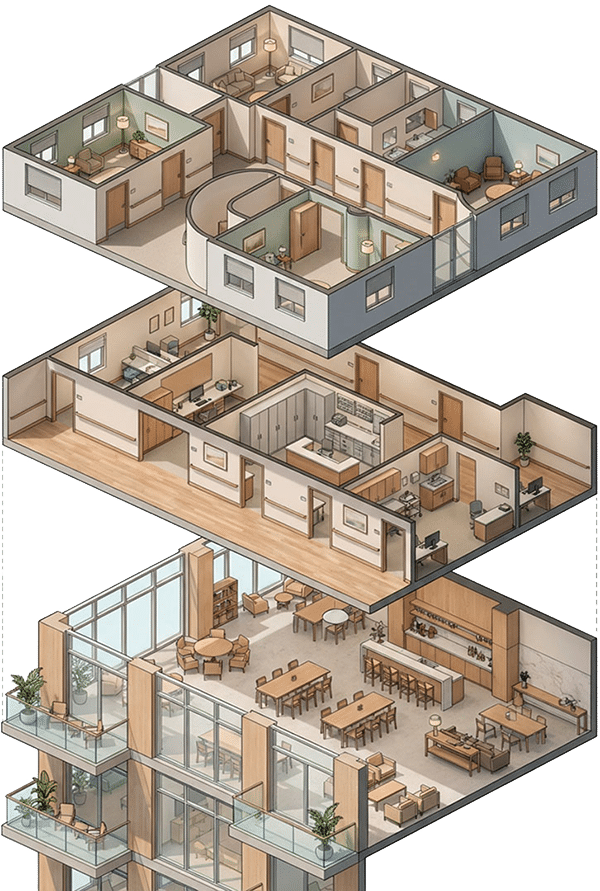
Real estate investors treat skilled nursing facilities as a distinct sector because they operate under an altogether different model, with thin margins and heightened regulatory risk.
Providing a consumer’s perspective is John Kraft, an economist and a former dean of the University of Florida’s Warrington College of Business. He and his wife paid $660,000 to move into Oak Hammock, a continuing care retirement community in Gainesville affiliated with UF. The couple pay about $10,000 a month for a 2,000-square-foot apartment in the independent living section of the 150-acre campus, which houses roughly 500 residents. The couple, both in their early 80s, are in good health, and Kraft remains active — teaching business courses, producing a podcast and boxing for exercise. He maintains a regular bridge game with other residents. He said certainty was a deciding factor in moving to Oak Hammock. For one thing the idea of “aging in place” in their single-family house seemed iffy because of a growing shortage of skilled home health providers. “It’s more difficult to get (home health) services than it is to get someone to repair your washer,” he said with a laugh.

For the broader market, however, there is a widening divide between certainty for the affluent and limited options for everyone else. The Harvard Joint Center for Housing Studies has warned that millions of older adults — especially middle-income households — will struggle to afford senior housing in the coming decade. Many live on fixed incomes, depend heavily on Social Security, or hold housing wealth that is difficult to convert into liquid assets. Researchers estimate that a substantial share of Americans in their 80s are strictly limited in their ability to pay for private-pay care.
Older adults today tend to move into senior housing later, often after a fall, medical event or sudden erosion of independence. Move-ins are less predictable, and length of stay has shortened in many markets, particularly for assisted living and memory care. Operators can’t assume that every 80-year-old represents a future resident.
There is a widening divide between certainty for the affluent and limited options for everyone else.

A Courtyard by Marriott approach
The affordability gap is where Pilar Carvajal has focused her career. Carvajal is founder and CEO of Innovation Senior Living, based in Winter Park, and describes her company as an anomaly. Her career began on the opposite end of the market, converting affordable housing into assisted living and serving low-income residents supported by Medicaid. In 2016, she shifted her focus to the middle market and her company now operates five adult day care, independent living, assisted living and memory care communities in Central Florida. It has an agreement to take over operations of three more. She describes her approach using a hospitality analogy. “I run more of that Courtyard Marriott type product,” she said, in contrast to the “Ritz-Carltons” that dominate the luxury end. Innovation Senior Living’s rents typically range from $3,000 to $4,000 a month.
I asked Carvajal what returns her private institutional and family office investors may expect. “In terms of operating returns, we can get anywhere from 30 to 40%. In terms of internal rate of return, anything from 15 to 20% … There’s also an ability to do more of a social impact type of a product, where maybe your returns are lower, but you’re serving a really large middle market. So, the returns are still there.” Carvajal’s model anticipates that some residents will eventually deplete assets and qualify for public assistance. “If you consider that Medicaid will supplement upwards of $2,000 a month, that individual has to come up with, say, $1,000, $1,500, an amount people can cover with Social Security that they can apply towards their room and board.”
High end

Practical

Restrained

Even with powerful demographics, the outcomes aren’t automatic for senior-housing facilities. The future customer will likely be older, more diverse and more financially uneven. And customers’ length of stay — a variable that drives so much of the business — remains difficult to predict.
At Oak Hammock, the reality is visible every day: Photos of residents who have recently died are posted above the mailboxes. Kraft, the former UF business school dean, said it may seem morbid. But he’s a realist. “It’s the way it is,” he said, with a shrug. He and his wife are reassured in knowing where they will spend the rest of their lives. “When you move in, you know what the end is.”
Related stories


Sign up for our mailing list
Thank you for submitting this form, %WCBFAFORMFN%
We will contact you shortly.
For the media
Looking for an expert or have an inquiry?
Submit your news
Contact us
Follow us on social
@ufwarrington | #BusinessGators