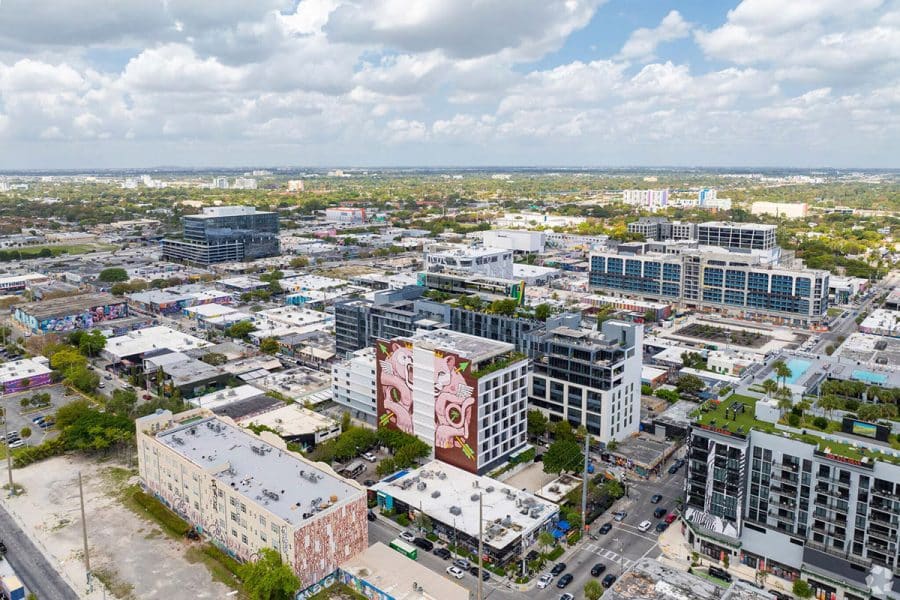
The obituary was premature
The narrative “office is dead” has been told in real estate circles for several years, a dramatic way to sum up the market’s worst-performing sector. And it’s misleading.
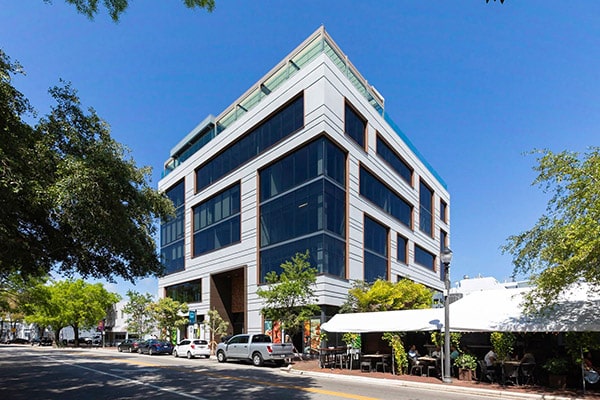
Scott Sherman says Torose Equities more than doubled its money when it bought the newly built — but vacant — Cube in Miami’s Wynwood neighborhood and sold it within about two years. Photo credit: LoopNet
Yes, there’s no doubt the latest data shows continued weakness: Third quarter 2025 vacancy rates for office space hit an all-time high of 14.1% nationwide, and effective rents remain under intense pressure, according to CoStar, the real estate market intelligence firm. The first sentence in CoStar’s latest report reads: “A geographically narrow rebound in some markets and an uncertain economic outlook have combined to dampen the office sector’s momentum.”
Additionally, the latest data from Green Street shows both rents and occupancy have fallen nationwide since 2019. (See Figures 1 and 2.) The Florida office market seems mixed. Metro Miami’s occupancy was 83.47% in this year’s third quarter, below 2019’s rate, though effective rent was up 2% to $35.83 a square foot. Similarly, occupancy in Tampa–St. Pete dipped to 86.46%, while effective rent has increased 2.5% to $22.13. The numbers are the latest sign that the office sector’s health has not recovered from the pandemic, when a surge of white-collar employees fled offices. Hybrid and remote work are “the new normal,” declared Stanford economist Nicholas Bloom, who leads an ongoing research project on remote work trends.
Source: Green Street
Source: Green Street
But if you thought it was time to roll up your sleeves for an autopsy, you’re missing a pulse. The question isn’t whether “office” has a positive future; it’s which offices, where and at what price.
Some prime properties in high-demand submarkets are getting record rents. Dire headlines miss the rebound going on in New York City, which is setting the pace for the rest of the country. Manhattan leasing activity in the first nine months of 2025 surpassed 2018-2019 levels, according to CBRE. New York also is even showing signs of recovery in lesser-quality Class B buildings — bucking the long-reported story that Class B offices are doomed as tenants flock to fancier digs to lure workers back to the office with extras like exercise rooms and coffee bars.
So, has the market hit bottom? The best answer depends on where you look. To get an on-the-ground view, we reached out to two Florida real estate veterans with differing perspectives.
Scott Sherman is a founder of Miami-based real estate investment firm Torose Equities — and a self-confessed contrarian. In recent years, Torose has bought more than 1 million square feet of office, and it now owns six buildings spanning from Coconut Grove and Coral Gables in Miami-Dade County to Tampa, Atlanta and Nashville.
Joe Brady is a longtime corporate real estate executive who led Walgreens’ real estate organization. He now works from his home in Ponte Vedra Beach, Fla., where he advises owners and tenants on workplace and portfolio strategies. In his 2024 book, “Work Shop: The Consumer-Driven Transformation of Commercial Real Estate,” he argues office is the new retail, a sector once declared dead in the face of online shopping platforms like Amazon.
Below are highlights of the interviews, edited and shortened.
Q: Today’s office market: Has it hit bottom? Or is it dead? Or something in between?
Sherman: There are a lot of suburban commodity offices across the country that are probably obsolete and probably won’t come back. In good markets, especially South Florida and Tampa and even parts of Orlando, there’s still office demand … Work from home is diminishing by the day. Companies are requiring employees back three, four, five days a week already. We’re seeing it in all of our buildings that we own—with the bodies in the offices, the parking lots being full … People are going back to the office.
Brady: That’s a misnomer (office being dead). It’s just that office and work are now decoupled. I’m not an advocate for 100% remote work … Something similar happened with retail 10, 12 years ago. And we’re doing it again in office. We’re talking about really, really complex subjects in a reductive way. It remains a story of haves and have-nots. Every single platform shift we’ve ever had has led to creative destruction. It’s an essential force, and we’re undoubtedly seeing that in corporate real estate.
Q: What’s working—and where?
Sherman: South Florida’s been resilient. (When shopping for offices to buy in metro Miami we found) rents were going up, occupancy was going up, demand was there, and values were going down. So, to me, it was like the most obvious buy opportunity I’ve seen in a long time because it just doesn’t make sense. Fundamentals are getting stronger and values are going down.
Brady: Location and product quality are doing the deciding. The split isn’t new—prime, mixed-use districts pull ahead while commodity space searches for a purpose … The macro says hybrid is durable; the micro shows demand concentrating in a handful of districts … If you have a best-in-class building, you haven’t had any issues. In fact, the One Vanderbilts of the world in New York City continue to demand $250 to $300 a square foot … We’re fortunate in Florida when you look at what Water Street has done (in Tampa) … and what’s happening in downtown Miami … Jacksonville has really gotten a lot of attention (with) live-work-play … There are 3,000 apartments coming (downtown). They just signed Publix and Whole Foods. These are all really good signs.
Q: People want to live close to the office?
Brady: I don’t think anyone likes to commute … When I lived in Chicago, when I ran Walgreens, I drove 26 miles each way. Most of the time it took me an hour and a half … People say they thought they hated their job, but it turns out they just hated their commute … There are certain jobs that are location dependent. There are others that are not and are untethered.
Q: Scott, can you provide examples with numbers that show your playbook?
Sherman: We bought a newly built, vacant office in (Miami’s trendy) Wynwood district in the middle of COVID … At the time we were buying it, it was pretty scary. But (sometimes) you got to lean in and go against the grain … Within two years we had it fully leased and sold it. The prior owner was into it for like $45 (million) to $50 million. We bought it for $28 (million) and then we sold it for $63 (million). In Coconut Grove we ended up buying the debt and then foreclosing (on a 50,000-square-foot) building. The prior ownership was into it for close to $60 million. We bought the debt in the low $40s … and I think we’re going to probably sell this thing north of $60 million.
Q: Tell us more about the buy side trends.
Sherman: Just in the last six months, I’ve definitely seen more people chasing (office). Now we’re starting to get into competition, bidding wars, and it’s starting to get a little more difficult. It’s not 2019, but you can feel the bid list thicken in the good submarkets.
Brady: Capital is selective, not absent. The first movers are already back to kicking tires on the best assets.
Q: How do you underwrite tenant risk in 2025?
Sherman: We look at how many leases were signed before and after COVID. For us, if it’s signed post ’22 that means it’s a right-sized tenant … But if it’s a pre-COVID tenant they may just be oversized and they need to adjust. We’re screening for post’22 leases, hybrid-friendly layouts and amenities that draw people—otherwise you’re negotiating from weakness.
Q: What does the capital stack and hold period look like?
Sherman: We kind of go deal by deal (backed by) high net worth family office type capital … That’s allowed us to buy in this kind of contrarian (space). Institutional capital was not touching office. Usually within three to five years we look to exit … If we need to hold for seven or 10 years we can be patient … We’re looking at 20-plus percent IRR over five years.
Q: What about back-to-work mandates? Amazon, Ford, even Zoom and the University of Florida ordered remote workers back to the office. Jamie Dimon, chairman and CEO of JP Morgan Chase, just made headlines for unveiling a $3 billion headquarters on Park Avenue in Manhattan with amenities that reportedly include a gym and 19 eateries. Many say working in the office is more productive, and it’s vital to people wanting to get ahead early in their careers.
Brady: I would tell you that before the pandemic, (worker office) occupancy averaged about four days a week. (At) peak pandemic (it was) one or half a day. It’s probably going to settle in at like three and a half … The question is less “how many days (are employees in the office)?” than “what are you coming in to do?” Young people absolutely should be in and around and learning. Casual collaboration (is important). We’re dealing with a generational issue; people need social connection. In addition to work connection, they need social connection.
Q: What are the risks ahead? The economy seems lukewarm, at best, interest rates remain relatively high and many say artificial intelligence (AI) will mean fewer white-collar workers.
Sherman: Rates can move the bid-ask quickly; we structure for that. On AI, we’ll see—some back-office roles could shrink, but teams still need places to build culture and work.
Brady: AI changes tasks before it changes entire occupations. That suggests different space, not no space.
Related stories



For the media
Looking for an expert or have an inquiry?
Submit your news
Contact us
Follow us on social
@ufwarrington | #BusinessGators