Construction of data centers booms, as does opposition
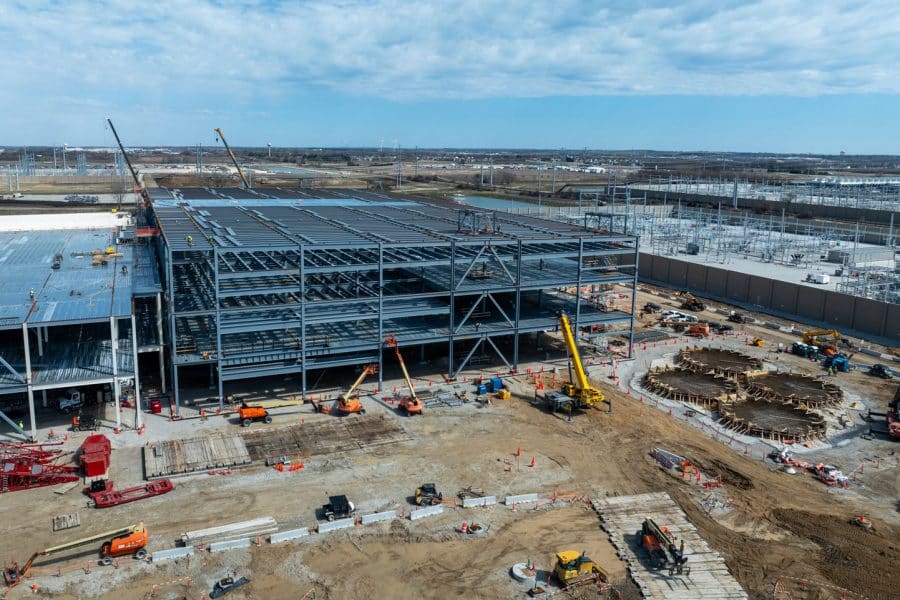
For over a year, the building of data centers has been bolstering an otherwise lackluster construction environment. According to U.S. Census Bureau data, spending on data center projects was up over 32% in 2025, while overall construction spending was down more than 1%.
Spending on data centers, which are categorized under the office sector of commercial real estate, hit a seasonally adjusted annual rate of $50.7 billion in April, according to an analysis of Census Bureau data by Associated Builders and Contractors, a national trade association.
“Private sector construction momentum has been difficult to find outside of the still-ascendant data center segment,” Anirban Basu, the group’s chief economist, said in a June press release announcing the finding.
But these projects have been facing growing opposition. In a Reuters/Ipsos survey of the general American population conducted in June, only 21% of total respondents said they supported the construction of new data centers in the U.S. And only 14% of respondents said they would support one being built in their community.
Local opposition
Environmental groups and residents in communities where data centers have been proposed often point to the resources that these buildings will use once in operation as a reason to block them. They question whether the existing electrical grid can handle the demands of powering the enormous artificial intelligence systems that tech giants are building and object to the large volumes of water often needed to cool such powerful computing equipment.
Some neighbors of existing data centers have complained about noise and other forms of pollution from the buildings, in addition to increases in utility bills that they attribute to the need for increased capacity from their local utility companies created by the centers. Others worry about utility companies spending billions of dollars on infrastructure upgrades with the expectation of having substantial new revenue sources that aren’t guaranteed. Whispers of a potential AI bubble can bring fears of bankrupt electricity providers, unfinished projects and cavernous buildings filled with aging equipment and no obvious use.
Officials said the county spent over $1.7 million on legal fees to defend the proposal from multiple lawsuits filed by nearby residents and the American Battlefield Trust.
As data centers grow both in size and number to meet the increasing demand for AI systems, streaming services and cloud storage, the strain they are placing on electricity providers is also growing. The Federal Energy Regulatory Commission (FERC) says that the average energy usage of a data center went from 25 megawatts in 2020 to nearly 80 MW for the ones entering service in 2025, with future capacities expected to increase further.
Data centers usually run at or near their usage capacity. So if a data center with 100 MW capacity runs for an entire day, it’s using around 2,400 MWh of electricity. In a month, it will use about 72,000 MWh. For comparison, the U.S. Energy Information Administration (EIA), the statistical and analytical agency within the U.S. Department of Energy, says that the average residential customer in the U.S. bought 899 kWh, or .899 MWh, of electricity per month in 2022.
“Project scales have multiplied beyond recognition,” Tony Qorri, vice president of construction at DataBank, a provider of data center services, wrote in a blog post on the company’s website. DataBank says its Red Oak campus, being built on nearly 300 acres outside of Dallas, will feature four buildings and a 400 MW substation in its first phase.
“Access to the power needed for ever-larger data centers is emerging as a critical bottleneck,” Boston Consulting Group said in a report last year. “Primarily, this results from a mismatch between the development period of two to three years for a typical greenfield data center and the time required to complete associated interconnection studies and infrastructure upgrades, which usually spans four to eight years.”
Rising electricity prices
Complaints about increases in electricity costs have become widespread. And for good reason. Electricity prices have been on the rise since 2021 (Figure 1). The average residential price per MWh was around $131.71 in 2020. It rose to around $173.53 in 2025. The largest yearly jump in price was from 2021 to 2022, when it went up more than $14.40 per MWh to reach nearly $152.
Source: U.S. Energy Information Administration
Something else occurred in 2022: the public release of OpenAI’s ChatGPT. ChatGPT, a generative AI chatbot, was quickly adopted by millions of users and its release greatly accelerated the investment in other AI companies and the release of rival chatbot models, further pushing up demand for the largest data centers — the hyperscalers.
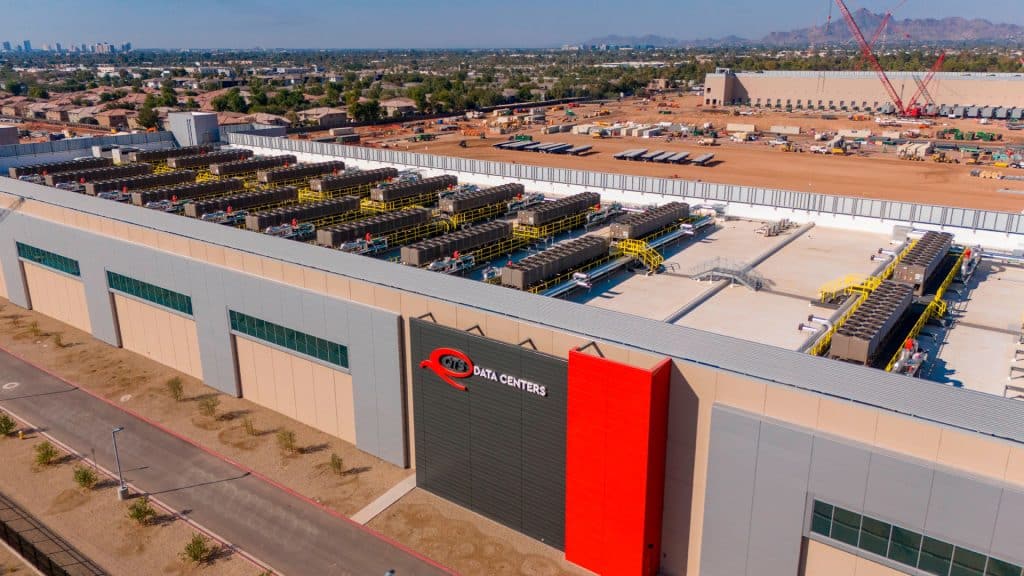
Many people inevitably noticed hikes in their utility bills just as AI chatbots were being unveiled and the construction of hyperscale data centers was making news. Hearing about buildings that drew unfathomable amounts of electricity while receiving record-breaking electric bills undoubtedly led many people to make a connection between the two phenomena, especially if they lived in an area where data centers were being built.
Data centers tend to be concentrated in certain areas with favorable conditions, such as cheap land and easy access to electricity, water supply and reliable, high-speed fiber optic network connections. Government incentives like tax breaks have also influenced location selection. The biggest data center hubs are currently in Virginia, Texas, California, Illinois, Georgia and Ohio. Virginia, which also has the advantage of being close to Washington and many federal offices, is home to far more data centers than any other state.
Still, even in Virginia, opposition is growing. The Prince William Digital Gateway, a planned complex for up to 37 data centers spanning some 2,000 acres at the edge of Manassas National Battlefield Park, was the subject of local protests. In March, the Virginia Court of Appeals upheld a lower court ruling invalidating zoning changes that had been made by Prince William County to allow for the development. The two data center companies involved, Blackstone-owned QTS and Compass Data Centers, have now given up on the multibillion-dollar project. Officials said the county spent over $1.7 million defending the proposal from multiple lawsuits filed by nearby residents and the American Battlefield Trust.
Politicians take notice
The growing angst over data centers has united people across the political spectrum and caught the attention of politicians. At least 75 projects worth approximately $130 billion were blocked or delayed in the first quarter of 2026, according to Data Center Watch, a nonpartisan research project. Dozens of moratoriums have been proposed at the local level, with some cities enacting complete bans.
According to the National Conference of State Legislatures, at least 15 states are considering or have considered moratoriums on the building of data centers. Such measures have failed in New Hampshire and Wisconsin. And in Maine, Gov. Janet Mills, a Democrat, vetoed LD 307, which would have put a hold on data centers over 20 MW until November 2027. Mills said she would have signed the bill into law if it had included an exception for a project underway in the town of Jay, which had overwhelming support among local residents.
New York passed the first statewide moratorium on July 14 when Gov. Kathy Hochul signed an executive order pausing the issuing of permits for data centers using 50 MW or more. A more restrictive bill targeting 20 MW or larger data centers was passed by the state legislature in June, but Hochul, a Democrat, has not signed it into law.
While Florida has not considered a full moratorium on data centers, Gov. Ron DeSantis, a Republican, signed SB 484 into law in May. The bill requires the state’s Public Service Commission to have data centers pay for their own utility infrastructure, though the final version also allows for non-disclosure agreements between state agencies and companies to keep plans hidden for up to a year — against the objections of some of its original sponsors.
“You should not pay one more red cent for electricity because of a hyperscale data center as an individual,” DeSantis said during a bill signing event in Lakeland. “That’s just not right for the most wealthy companies in the history of the world to come in and have individual Floridians or Americans subsidize these hyperscale data centers.”
Recognizing an energy shortfall
The U.S. market system for electricity is complex, involving regulated and deregulated components. Regional Transmission Organizations (RTOs) and Independent System Operators (ISOs) manage markets accounting for two-thirds of the national electricity load and are overseen by FERC. These nonprofit regional grid operators purchase most of their electricity at base residual auctions (BRAs), which are held three years ahead of time — making accurate forecasting crucial. The rest of the country has more traditional structures, where utilities often own the generation, transmission and distribution systems, and are overseen by both state and federal agencies.
The largest RTO in the country, PJM Interconnection, coordinates the movement of electricity through all or parts of 13 states and the District of Columbia, providing power to more than 67 million people. It has the most data centers in its territory, including the major hubs of Virginia and Ohio. In January, the governors of the states served by PJM signed a White House directive calling on it to hold “a Reliability Backstop Auction to procure new capacity resources commencing no later than September 2026.” The directive also said that PJM should pass the costs of the new capacity on to utilities, and that the governors would then work to make sure that data centers paid their share of these costs.
In April, PJM proposed a reliability backstop plan that it said aligned with the directive’s principles. In a white paper outlining its proposal, PJM said, “Current projections show a potential capacity shortfall of 50 GW to 60 GW in the next decade, primarily driven by large load growth but also forecasted conventional load growth.”
In May, Monitoring Analytics, the fully independent external market monitor for PJM, released a report saying: “The amount that PJM is short capacity grew from 208.7 MW in the 2026/2027 BRA to 6,516.6 MW in the 2027/2028 BRA. The price impacts on customers have been very large and are not reversible. The price impacts will be even larger in the near term unless the issues associated with data center load are addressed in a timely manner.”
On July 14, PJM announced the results of its 2028/2029 BRA, which fell short of its reliability requirement by another 6,831 MW. The reliability requirement is the amount of energy PJM expects to need at its peak level of demand, plus a cushion. Joseph Bowring, Monitoring Analytics’ president, told Bloomberg that the monitor estimated that $6.3 billion of the $16.4 billion spent on the auction was for power needed by data centers.
“These auction results show that demand for electricity continues to grow faster than electricity supply,” David Mills, the PJM president and CEO, said in a statement. “PJM recognizes how this supply-and-demand imbalance impacts the reliability of the system and costs for consumers. We are working with government and industry leaders on multiple fronts to restore that balance by bringing on new generation as fast as possible and managing the growth of new load on the grid.”
Looking for solutions
Many electricity suppliers are using utility tariffs to try to make data centers pay for the extra costs associated with providing large loads of electricity. The Smart Electric Power Alliance (SEPA), a nonprofit that aids utilities in implementing clean energy systems, tracks such efforts in a database. It has 77 tariffs or similar service rules listed, though not all have been implemented. Some tariffs not only require certain rates and costs be paid by large-load users, but also that adequate collateral be provided before those users are connected to the grid. Many also have minimum charges written into them, to help ensure that load estimates are accurate.
We are setting the stage for a resilient, reliable, and forward-thinking grid that empowers communities and safeguards consumers by transforming the way large energy users access the grid.
Laura V. Swett, the FERC chair
Some utility providers and data center operators are also open to the idea of placing a power generator next to large-load users. In this co-location scenario, the power generator could be owned and operated by the data center or the utility. When generation and consumption occur at one site without electricity entering the grid, it cuts out potential issues with overloading transmission lines and can curb effects on the wholesale energy market. But such arrangements are new, and many details still need to be worked out between regulators, traditional electricity providers and developers. And the costs can be astronomical.
“Power infrastructure costs are creating a significant barrier to entry,” Qorri, the DataBank vice president, wrote on the company’s blog. “Operators pursuing geothermal energy, high-pressure gas lines with turbines, or small modular reactors face capital requirements in the hundreds of millions before a single tenant moves in.”

The alternative is transferring this risk to existing utility consumers, something regulators are trying to prevent. On June 18, FERC issued separate show-cause orders to each of the six regional grid operators, telling them to explain or reform their tariffs on large-load users, including data centers. It gave the RTOs and ISOs 60 days to respond by showing their current tariffs are both reasonable and transparent or to submit new tariff proposals.
“We are setting the stage for a resilient, reliable, and forward-thinking grid that empowers communities and safeguards consumers by transforming the way large energy users access the grid,” Laura V. Swett, the FERC chair, said in a statement.
Hyperscale data center effects
While energy prices have undoubtedly been going up, we wondered if commonly held perceptions about data centers being the cause were correct. We examined electricity usage and rates, comparing areas with hyperscale data centers to those without them. For our study, we defined hyperscalers as those with an electricity usage capacity of 100 MW or more.
Ideally, these data centers and their energy use would be traced to verify data center driven price hikes, but it is hard to even know the exact number of data centers currently operating in the U.S. Many owners and builders are not transparent about their operations. Some sources say there are 5,000 data centers, though most are not hyperscalers. Cleanview, a firm tracking power infrastructure and data center development, estimated that there were 1,100 data centers in operation as of June, with more than an additional 1,500 under construction or proposed.
Our primary data came from several sources. We used a publicly available dataset from FracTracker Alliance, a nonprofit that originated as a project of the Center for Healthy Environments and Communities at the University of Pittsburgh. This dataset had information on the ownership, location and size of data centers. Data Center Map, an industry database, gave us a list of data centers with their operational statuses. We then searched the web for information about when each running hyperscaler first opened. The rest of our data came from EIA. Its Form 861M reports total annual electricity sales, usage and revenue by utility service provider and by type of customer — residential, commercial or industrial. EIA has listed data centers as commercial customers going back to at least 2012.
We found that 33 data centers with a capacity of at least 100 MW became operational in the last six years. We then explored whether there was an increase in electricity usage in the states with these centers, using an event study technique to compare the energy usage in the group of states with a hyperscale data center with the energy usage in the group of states without a hyperscaler. We used a time-to-event variable to account for differences in when states got hyperscalers.
Figure 2 and Figure 3 show the change in electricity usage for residential customers and commercial customers, respectively, in the years after hyperscalers open. While both sectors showed increases, the changes in residential usage were small and we were unable to detect statistical significance in them. The increase in commercial usage was larger — between 2-3% each year — and was found to be statistically significant.
While electricity supply is scheduled in day-ahead markets based on hourly demand forecasts and generator bids, actual system balancing and pricing also occur in real time. An increase in demand would generally raise wholesale prices in the short run. However, the extent to which this affects commercial rates depends on market structure and regulation, as many retail prices are smoothed or fixed over time.
Source: U.S. Energy Information Administration
Source: U.S. Energy Information Administration
In addition, large consumers often secure long-term contracts, which can partially insulate them from short-term price fluctuations in wholesale markets. Rates for commercial users are usually lower than residential users, who generally lack bargaining power. Cost increases faced by utilities may eventually be passed through to these consumers, but typically with a lag and subject to regulatory approval, resulting in a weaker and less immediate link between wholesale price movements and retail residential rates.
We explored unit prices paid by these two sectors. We calculated average electricity rates by dividing the reported total sales figures by the reported total MWhs of electricity used within a sector. Figures 4 and 5 plot the residential and commercial rates, respectively, adjusted for inflation and split into a group of the states having at least one hyperscale data center (hyperscaler) and a group of those that don’t (non-hyperscaler). Inflation-adjusted prices changed only moderately for both sectors in both hyperscale and non-hyperscale states. For both sectors, there was an increasing trend between 2020 and 2022, however, that trend has flattened out post-2022. Comparing Figure 1 with Figure 4 shows that the recent increases in residential electricity rates can largely be explained by inflation.
Source: U.S. Energy Information Administration
Source: U.S. Energy Information Administration
Average rates for both sectors were actually lower in states that had hyperscale data centers than in states without hyperscale data centers. But that was true even before the hyperscalers were being built, as low cost of electricity is a major factor in choosing locations to build data centers. Another interesting finding is that in hyperscaler states, the inflation-adjusted price of electricity for the commercial sector fell after 2022 — a trend not experienced by the commercial customers in non-hyperscaler states or by either group of residential customers.
To summarize, while there are numerous reports of increases in residential utility bills, this is mostly a consequence of observing the raw numbers and is only a part of broader, economy-wide inflation. We could not validate that residential customers are systematically paying higher rates in hyperscaler states compared to non–hyperscaler states. Nonetheless, as data centers are likely to remain a critical component of future digital infrastructure, the policy challenge lies in ensuring that the benefits of their expansion are balanced with fair cost distribution and transparent rate-setting mechanisms for all consumers.
Proactive Planning
While there are significant challenges to developing a large data center project, it seems that if due diligence is done in the planning stages — selecting a site in an area with adequate available resources and favorable zoning, and having a strategy to proactively address residents’ concerns — some of the biggest problems can be avoided.
We found that so far, the data don’t support the idea that residents have experienced large price increases in electricity rates because of hyperscale data centers being built nearby. But that doesn’t mean that that couldn’t happen in the future, especially as it comes time to pay for the capacity procured in recent auctions. The risk remains, as do the risks of other commonly expressed concerns — the potential for high demand for water, disruptive noise levels, air pollution and other land usage issues.
Data center developers and operators should be prepared to explain their plans to concerned citizens — including what steps they are taking to ensure the costs of their electricity usage won’t be passed on, whether that be through pre-negotiated purchasing agreements, putting up collateral, paying tariffs, investment in infrastructure or by building their own power generation. Such measures could ease fears of the worst-case scenario: a utility overextending itself to pay for increased capacity for a planned project that falls through, leaving residential users paying the bill for upgrades that were never actually needed.
It is undeniable that data centers will continue to be built. But for now, negative perceptions are a major challenge to developers, one that can stop even the largest projects, as seen with the Prince William Digital Gateway in Virginia. On the other hand, it was the broad support of a data center project by the residents of the town of Jay that stopped a moratorium from going into effect in Maine. As regulations and protocols for handling large-load customers are developed and standardized, it is likely that such projects will be seen more and more often as routine. And as more projects come online without wreaking havoc, opposition may even fade.
Related stories



Sign up for our mailing list
Thank you for submitting this form, %WCBFAFORMFN%
We will contact you shortly.
For the media
Looking for an expert or have an inquiry?
Submit your news
Contact us
Follow us on social
@ufwarrington | #BusinessGators